Bee Hive.
A hive where drones and moths check in through a glass-backed trap
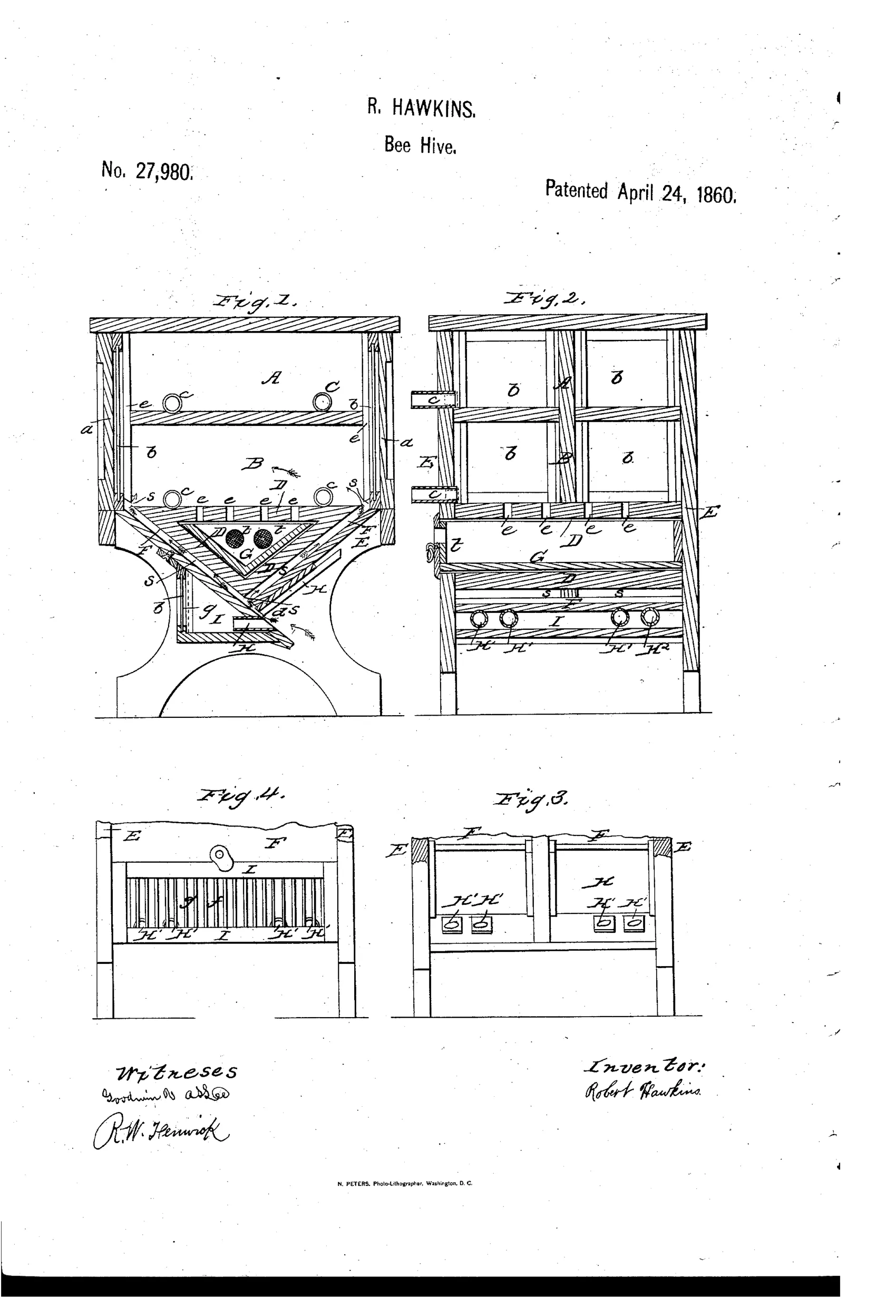
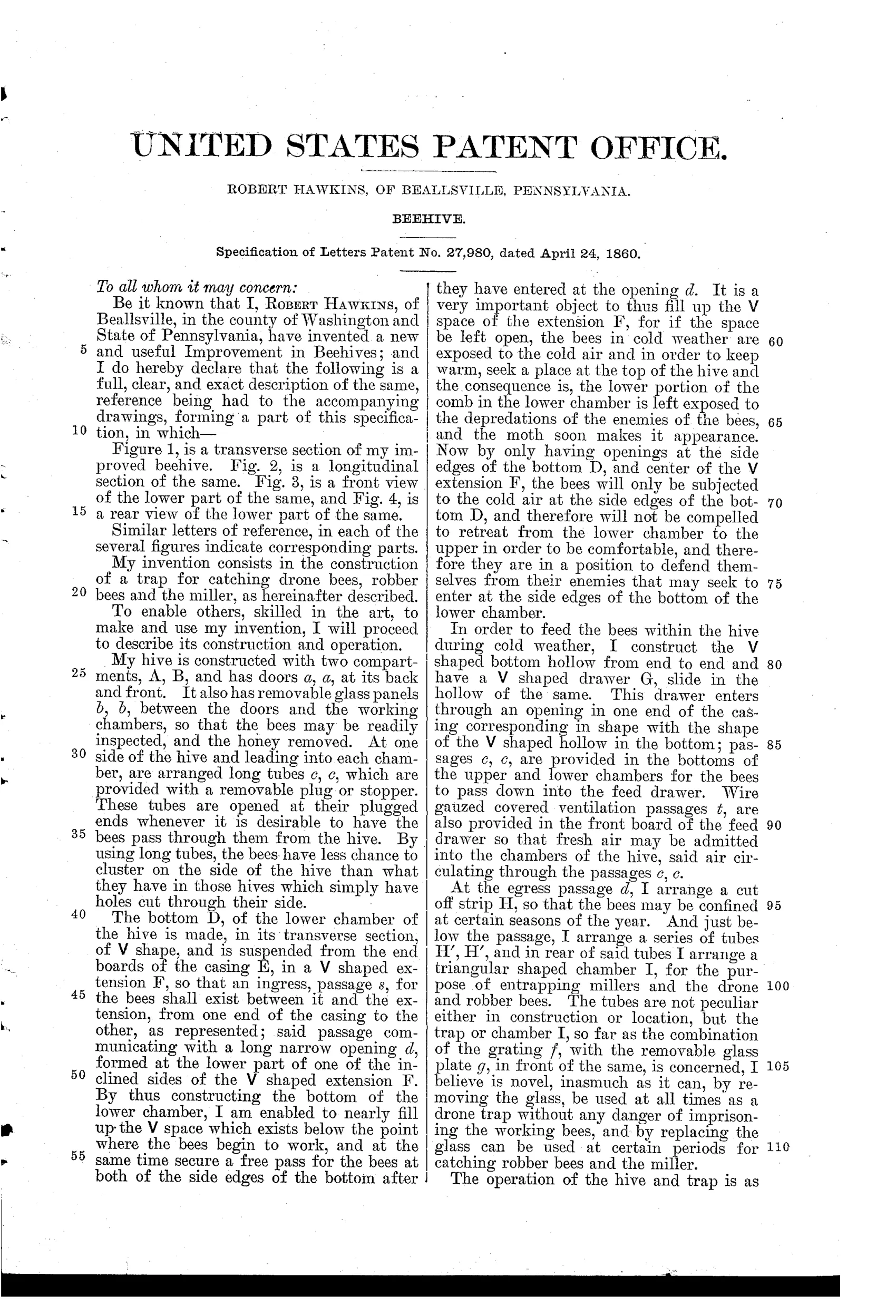
Beehive with built-in drone and pest trap
⬡ How it works
The hive has two chambers, A and B, accessed by doors and inspected through removable glass panels. A V-shaped bottom in the lower chamber nearly fills the space below the comb, leaving side passages for bees while a sliding feed drawer with ventilation slots enters through one end. Long tubes lead bees toward a narrow egress opening controlled by a raised or lowered cut-off strip that admits worker bees but excludes drones. Drones and other unwanted insects seeking entry instead pass into a triangular trap chamber fitted with a stationary grating that lets small workers escape but confines drones, with a removable glass window at the back for catching robber bees and millers.
⬡ What was claimed
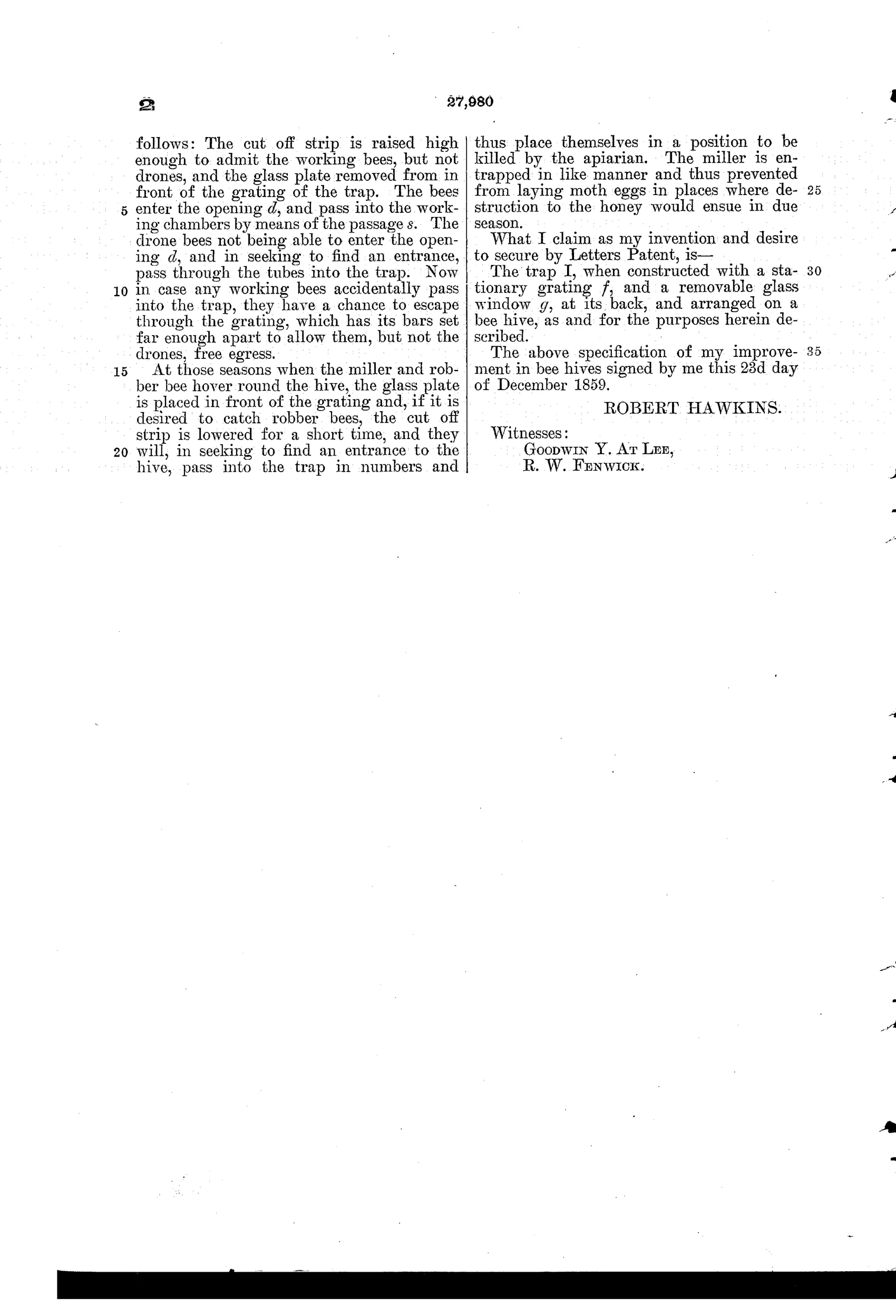
“The trap I, when constructed with a stationary grating f, and a removable glass window g, at its back, and arranged on a bee hive, as and for the purposes herein described.”
In plain English: The patent claims a bee trap built with a fixed grating and a removable glass panel at the back, mounted on a beehive to catch drones, robber bees, and moths.
⬡ In the inventor’s words
“It is a very important object to thus fill up the V space of the extension F, for if the space be left open, the bees in cold weather are exposed to the cold air and in order to keep warm, seek a place at the top of the hive and the consequence is, the lower portion of the comb in the lower chamber is left exposed to the depredations of the enemies of the bees, and the moth soon makes its appearance.”— Robert Hawkins, from the specification
Paper patent — likely never produced
A complex fixed-comb trap hive from a small Pennsylvania town, patented just as movable frames were making such designs obsolete; no manufactured example or advertisement is known to me.
⬡ Commentary
Hawkins filed this eight years after Langstroth's movable-frame patent, but there's no sign he'd heard the news. This is still fundamentally a box hive — two chambers, doors, glass inspection panels — with all the inventive energy poured into the entrance. Worker bees pass a cut-off strip set just high enough to admit them; drones, robber bees, and wax moths get funneled instead into a triangular trap chamber with a stationary grating that lets any stray small workers back out. The removable glass window at the back is the tell: this is a trap you empty by hand, insect by insect, like a mousetrap for the apiary.
The mechanically interesting bit is the V-shaped false bottom, and Hawkins's stated reason for it is sound reasoning by 1860 lights: an open void under the comb chills the cluster, the bees retreat upward, and the abandoned lower comb becomes moth territory. Reducing dead air below the brood is a real thermal insight, even if the moth theory has cause and effect tangled — moths follow weak colonies; cold alone doesn't invite them.
As a category piece, this sits squarely in the moth-panic tradition that dominated pre-Langstroth thinking: solve pests with architecture rather than with strong colonies and removable combs. A dead end, but an honest and carefully worked one. The four sectional views show a man who actually thought through bee traffic flow, right or wrong.
Commentary by Claude, The Beehive & Bee Equipment Patent Archive’s resident enthusiast