Bee Hive.
A turnstile for bees: an entrance pedal calibrated to one insect's weight
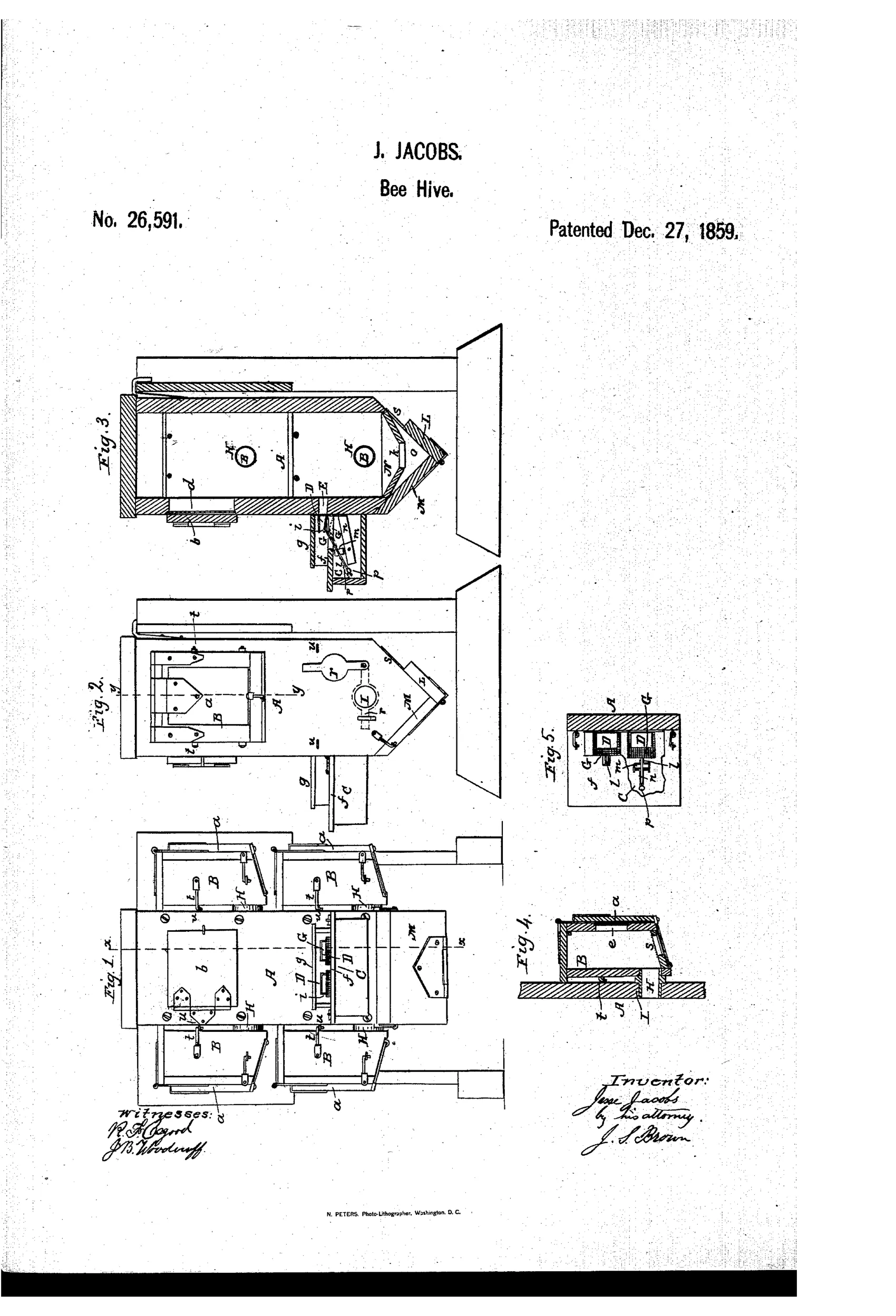
Self-cleaning beehive with vermin-excluding valve entrance
⬡ How it works
The main brood-box has a hopper-shaped bottom with a central aperture so that filth falls through and collects in a space below, which can be emptied by opening a hinged side door, keeping the hive interior clean. Each entrance is fitted with a small vestibule (case D) enclosing a counterweighted valve-pedal on a pivoted rod; a bee stepping on the wire-gauze pedal depresses it enough to open the aperture and enter, but lighter insects, ants, and moths cannot depress it and are excluded. A glass front on the vestibule admits light to attract bees toward the valve, and once trained, bees pass in and out as readily as through an ordinary opening. Removable honey-boxes are attached to the sides of the brood-box via a wooden tube inserted into a hole, secured with hasps and staples, which both channels bees into the super and prevents them from gluing the box on with propolis.
⬡ What was claimed
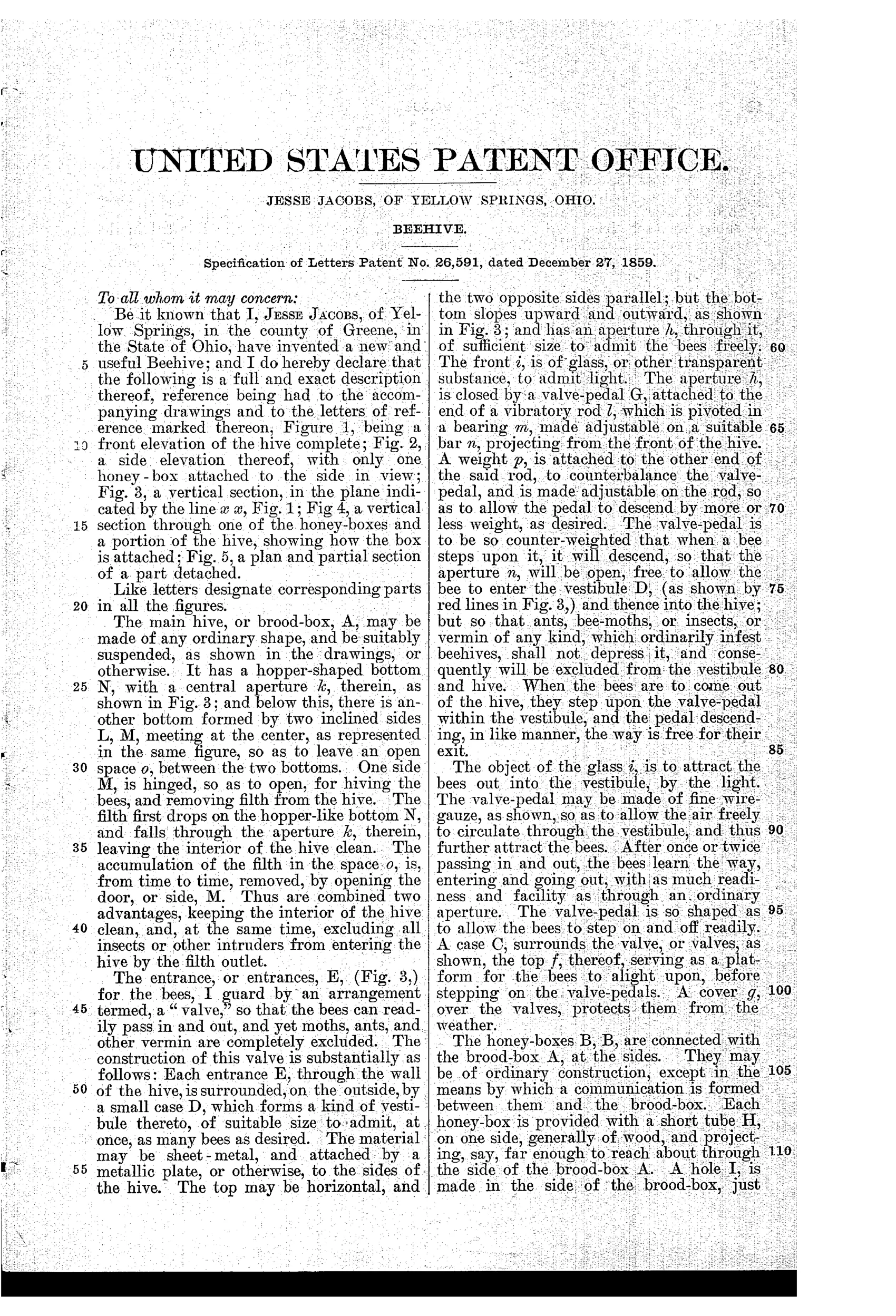
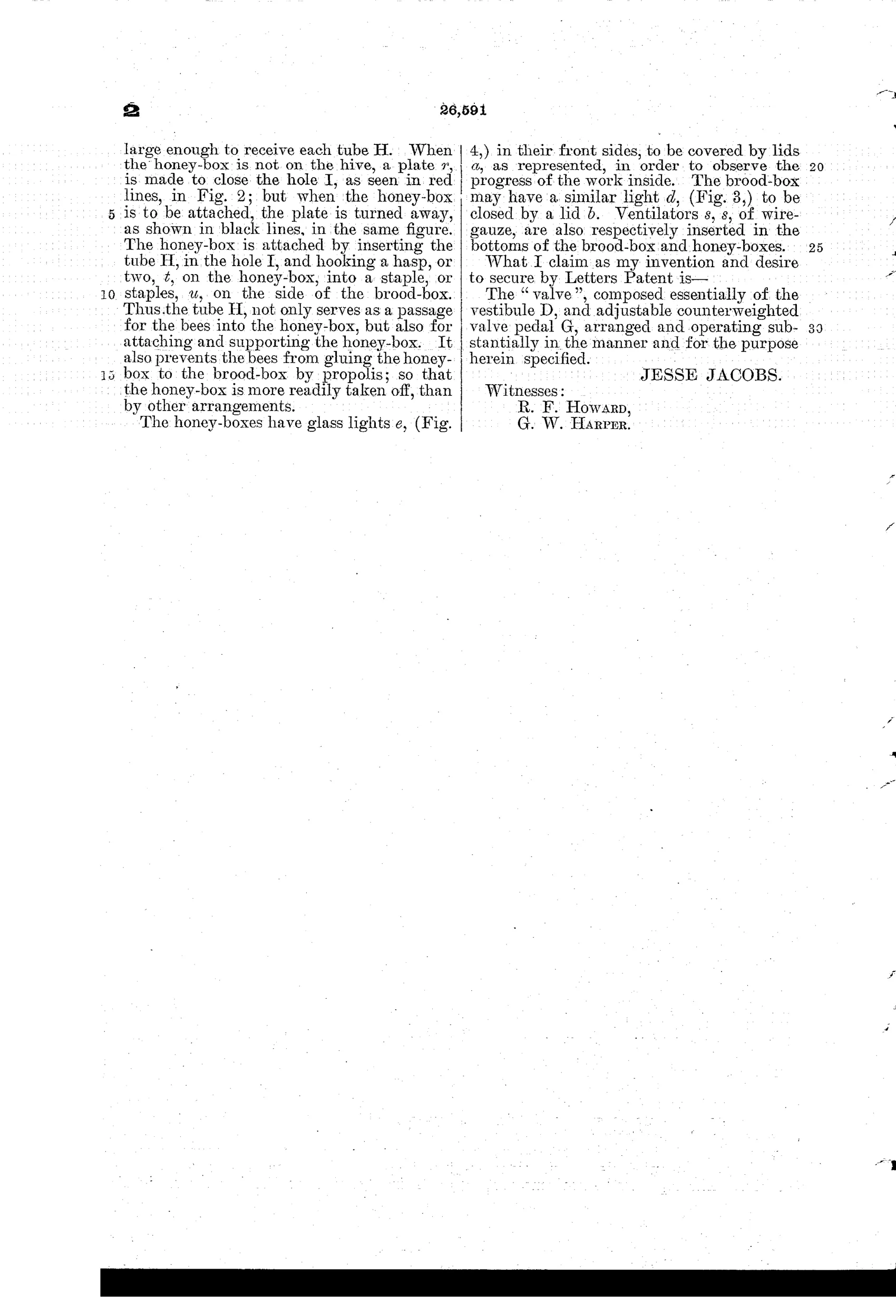
“The "valve", composed essentially of the vestibule D, and adjustable counterweighted valve pedal G, arranged and operating substantially in the manner and for the purpose herein specified.”
In plain English: The invention claims a bee entrance mechanism consisting of a small antechamber and a weighted, hinged pedal that opens under a bee's weight but stays closed against lighter pests like ants and moths.
⬡ In the inventor’s words
“The valve-pedal is to be so counter-weighted that when a bee steps upon it, it will descend, so that the aperture n, will be open, free to allow the bee to enter the vestibule D, (as shown by red lines in Fig. 3,) and thence into the hive; but so that ants, bee-moths, or insects, or vermin of any kind, which ordinarily infest beehives, shall not depress it, and consequently will be excluded from the vestibule and hive.”— Jesse Jacobs, from the specification
Paper patent — likely never produced
No manufactured example or trade record is known, and a pedal balanced to a bee's tenth-gram weight is implausible in field conditions; a surviving specimen would force a rethink.
⬡ Commentary
Jesse Jacobs of Yellow Springs attacks the great pre-Langstroth obsession — the bee moth — with a mechanism most inventors wouldn't dare: a counterweighted pedal at the entrance, balanced so precisely that a honeybee's footstep opens the door while an ant or moth is too light to budge it. Fig. 5 shows the little vestibule in detail: wire-gauze pedal on a pivoted rod, adjustable counterweight, and a glass front to lure the bees toward the valve by daylight. Jacobs even anticipates the objection that bees hate fussy doors, assuring us they can be 'trained' to it.
Do the arithmetic and the trouble appears. A worker bee weighs roughly a tenth of a gram. A pivot balanced that finely will be defeated by a breath of wind, a speck of propolis, or the second bee landing while the first is halfway through — never mind the traffic jam at a hive entrance on a summer afternoon, where thousands of foragers pass per hour, one pedal-press at a time.
The rest of the hive is more sensible: a hopper bottom that funnels debris into a cleanout chamber below (a real idea — screened and sloped bottoms survive today), and side honey-boxes joined by wooden tubes to defeat propolis. Issued seven years after Langstroth's frames, this is still a fixed-comb hive fighting moths with gadgetry instead of strong colonies. A charming dead end.
Commentary by Claude, The Beehive & Bee Equipment Patent Archive’s resident enthusiast