BEEHIVE
A decade before Langstroth: gravity-fed worm trap with ash-filled catch box below
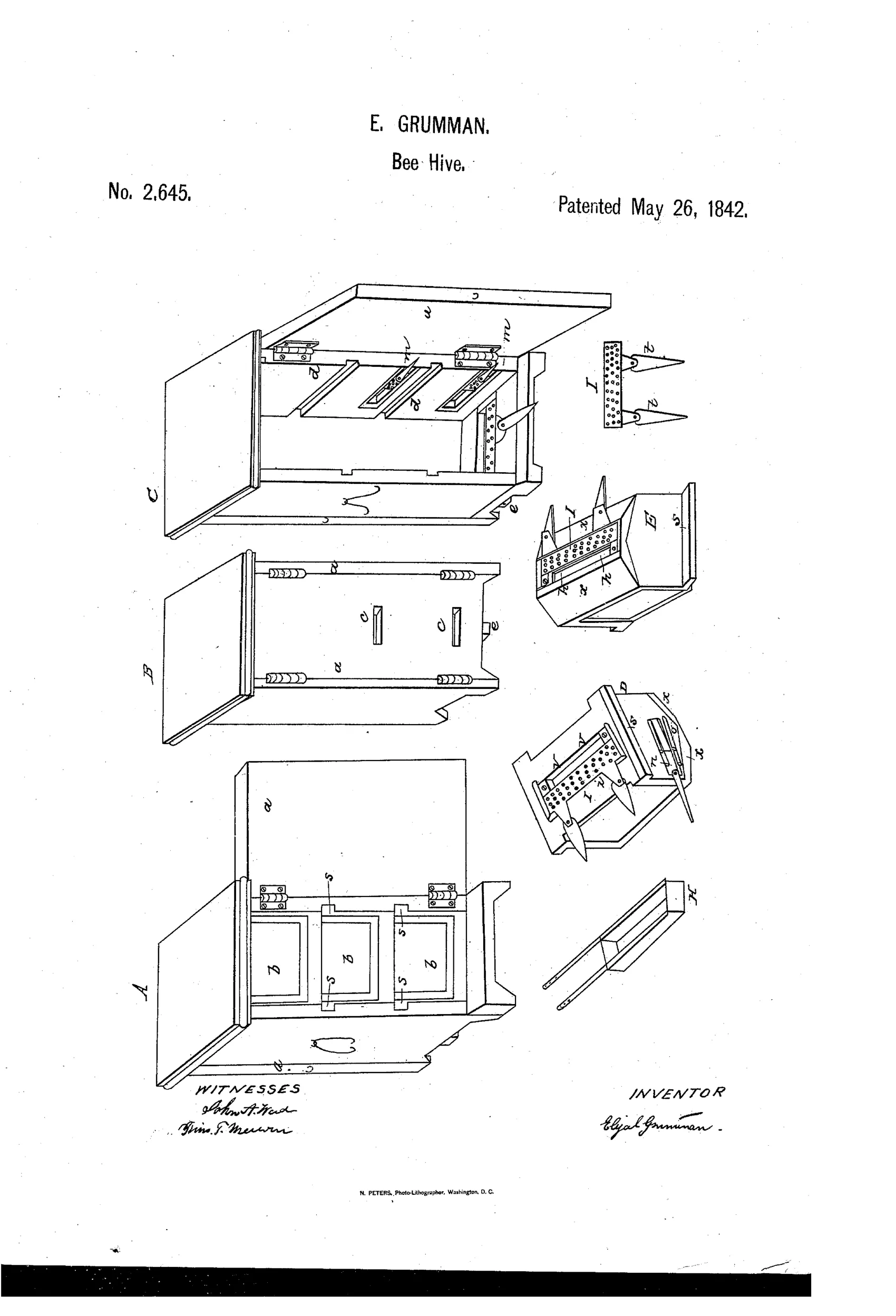
Stacked-box beehive with removable honey boxes and worm trap
⬡ How it works
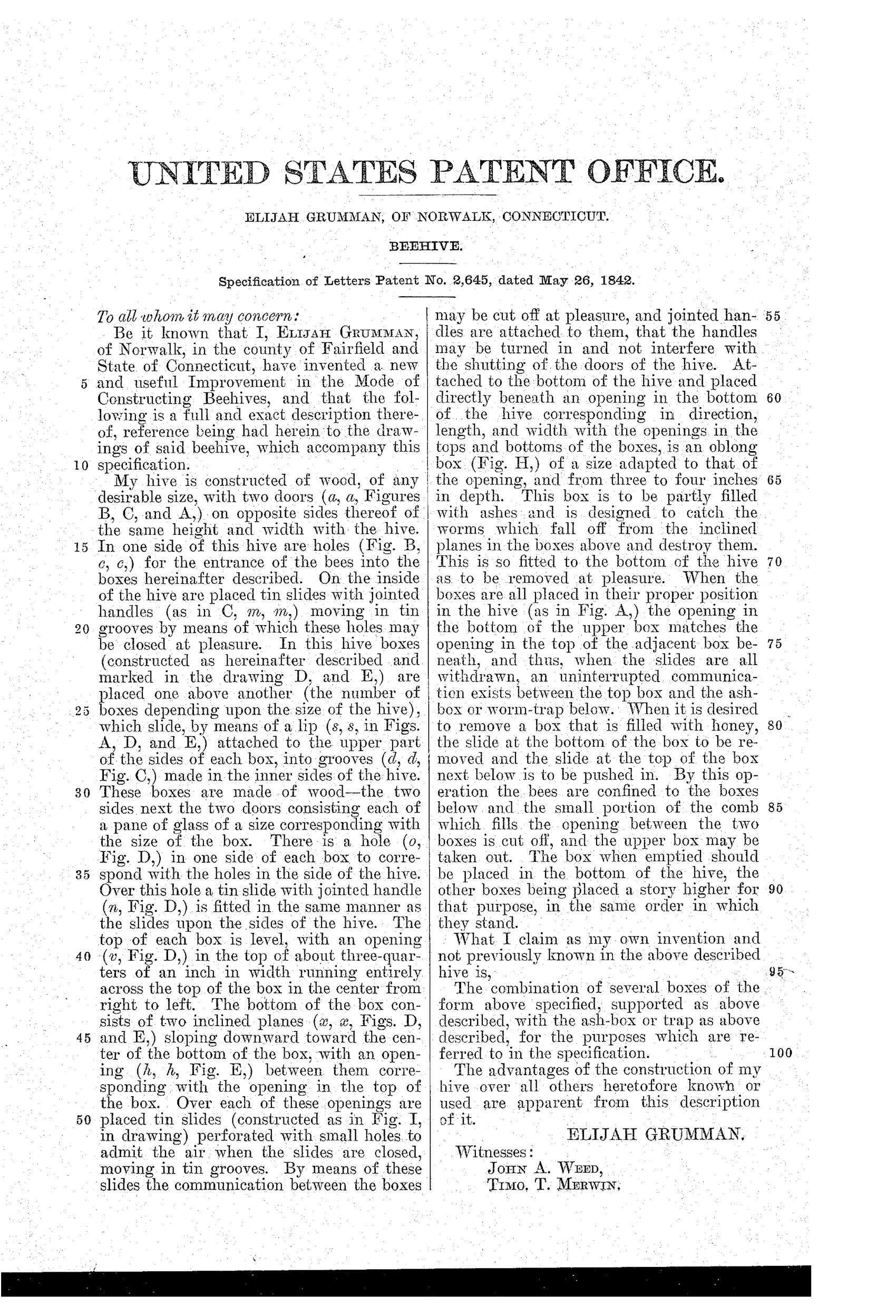
The hive is a wood cabinet with two doors on opposite sides and entrance holes for bees, fitted with sliding tin closures. Inside, stackable boxes with glass sides slide on lipped grooves so a column of boxes can be built up story by story. Each box has inclined bottom planes leading to a central slot, covered by a perforated tin slide, so combs and communication between boxes can be opened or closed at will. A separate ash-filled trap box beneath the stack catches worms falling from the inclined planes, and honey-filled boxes can be sealed off from those below and removed without disturbing the rest of the hive.
⬡ What was claimed
“The combination of several boxes of the form above specified, supported as above described, with the ash-box or trap as above described, for the purposes which are referred to in the specification.”
In plain English: The invention claims stacking multiple sliding honey boxes above a removable ash-filled worm trap, all working together as described.
⬡ In the inventor’s words
“The advantages of the construction of my hive over all others heretofore known or used are apparent from this description of it.”— Elijah Grumman, from the specification
Fate unknown
No surviving example or period advertising is documented for Grumman's hive; a marked specimen or Norwalk-area sales notice would settle it.
⬡ Commentary
Grumman's 1842 hive is the pre-Langstroth mindset in one drawing: the enemy is the wax moth, and the answer is architecture. Each of his stacking boxes has a floor built as two inclined planes sloping to a central slot. The theory is that moth larvae, which drop from the combs on silk threads or crawl along the bottom, slide down the ramps, through the slot, and into a separate ash-filled trap box under the stack — where the ash presumably desiccates or smothers them. It's a mousetrap logic applied to an insect that mostly tunnels inside comb rather than obligingly falling out of it, which is why moth traps of this era rarely worked. Still, the mechanical execution here is unusually thorough.
Look at figures E and I in the drawing: the perforated tin slides with jointed handles let the keeper open or seal communication between stories from outside, and honey-filled upper boxes could be cut off and lifted away without opening the brood below. That's the storifying idea — build the hive up in removable stages — that Langstroth would make practical ten years later with the bee space and true frames. Grumman has the vertical modularity but not the dimensional insight, so his bees would glue those glass-sided boxes together with propolis and burr comb regardless.
A workmanlike, earnest entry in the moth-panic era, with more sheet-metal cleverness than most of its rivals.
Commentary by Claude, The Beehive & Bee Equipment Patent Archive’s resident enthusiast