HONEY-COMB-UNCAPPING MACHINE.
A foot-treadle scissor machine to uncap combs, forty years before anyone succeeded
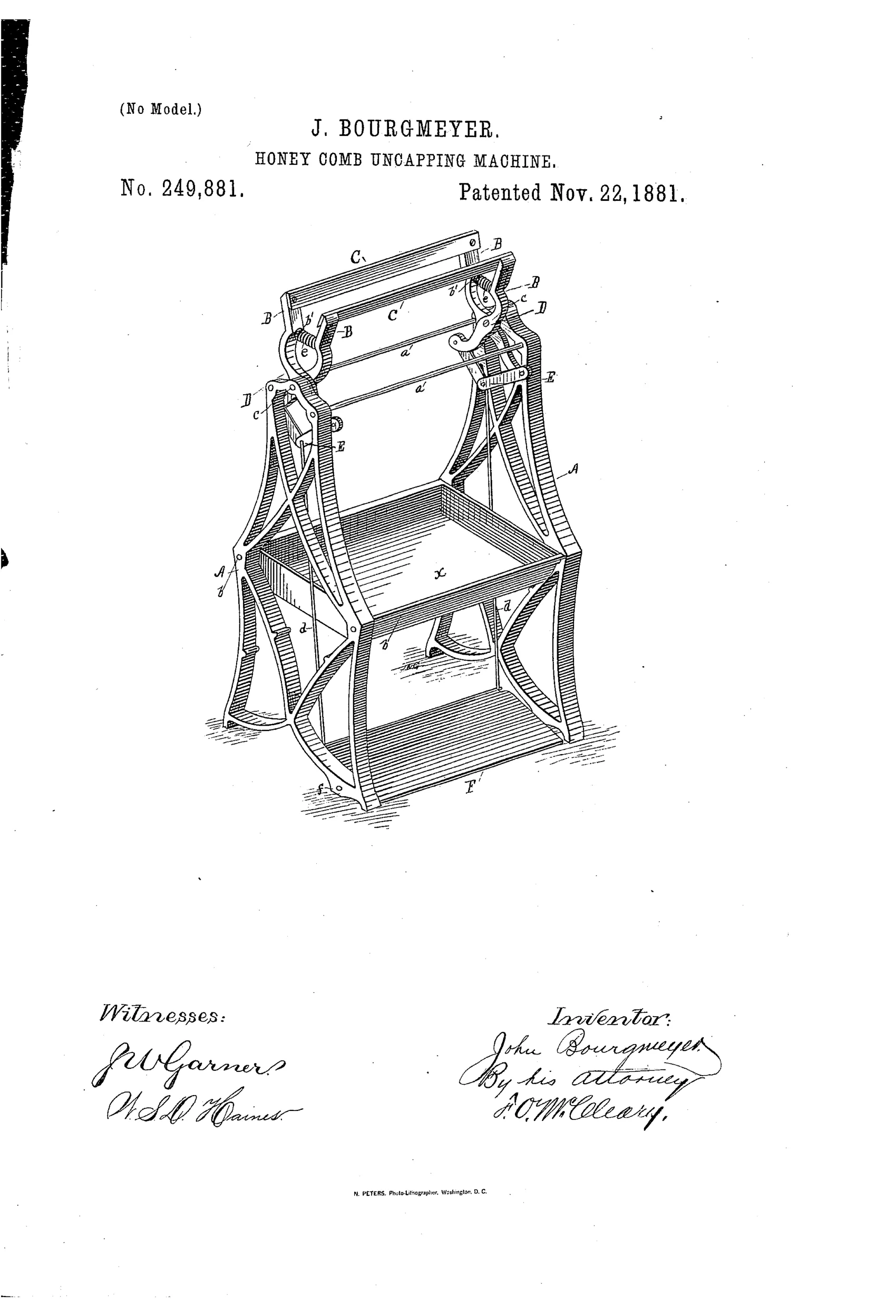
Treadle-operated machine for uncapping honey combs
⬡ How it works
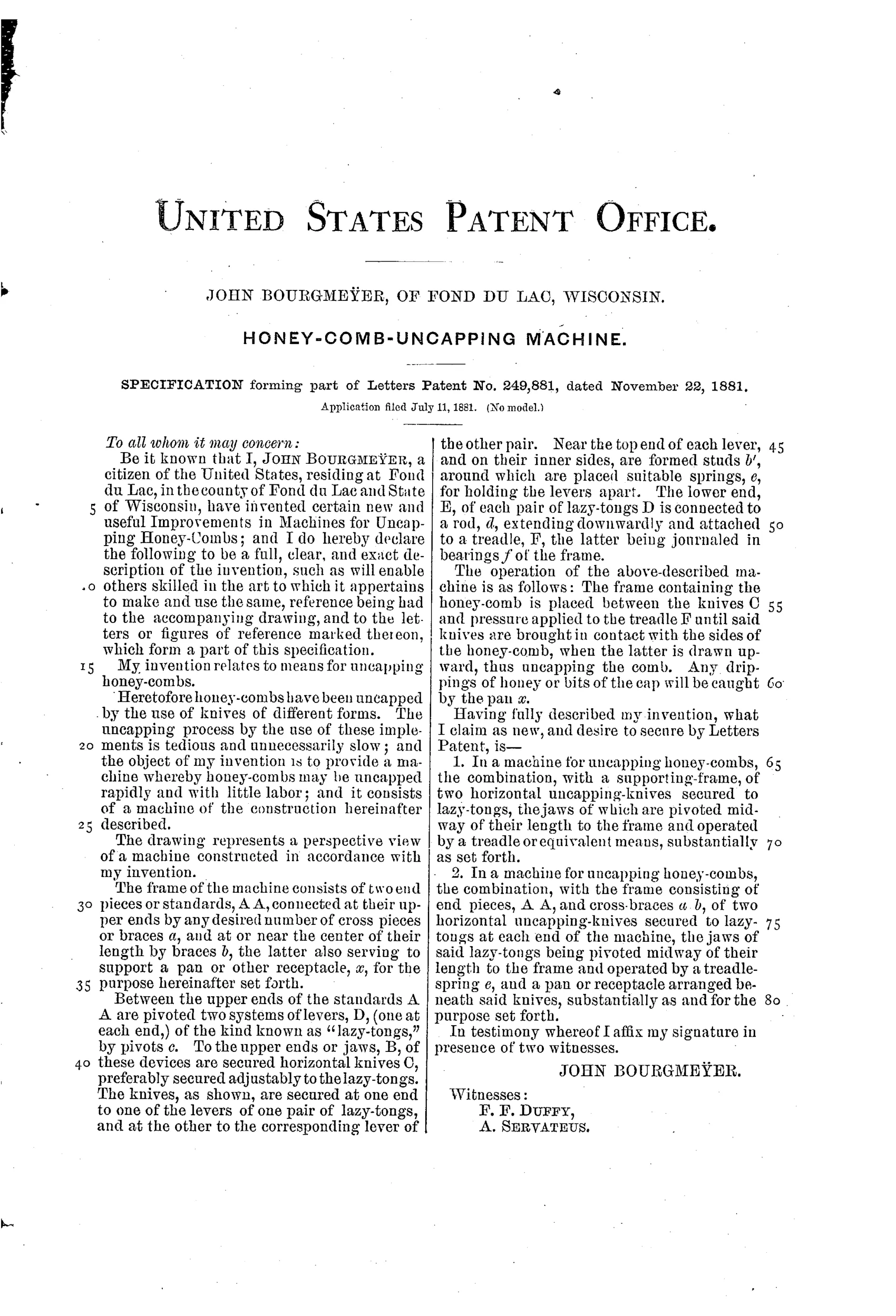
The frame consists of two end standards connected by cross braces, between which are pivoted two systems of lazy-tongs levers at each end. Horizontal knives are secured to the jaws of the lazy-tongs, one knife end fixed to one lever and the other to the corresponding lever of the opposite pair. Springs placed around studs near the top of the levers hold the levers and knives apart until pressure is applied. A treadle connected by a rod to the lower end of the lazy-tongs draws the knives together against the sides of a honey-comb placed between them, and pressing the treadle then draws the comb upward, uncapping it, with drippings caught in a pan beneath.
⬡ What was claimed
“In a machine for uncapping honey-combs, the combination, with a supporting-frame, of two horizontal uncapping-knives secured to lazy-tongs, the jaws of which are pivoted midway of their length to the frame and operated by a treadle or equivalent means, substantially as set forth.”
In plain English: The invention combines a frame holding two horizontal knives mounted on scissor-like lazy-tongs, pivoted at their midpoints, which are opened and closed by a foot treadle to uncap honey combs.
⬡ In the inventor’s words
“The uncapping process by the use of these implements is tedious and unnecessarily slow; and the object of my invention is to provide a machine whereby honey-combs may be uncapped rapidly and with little labor.”— John Bourgmeyer, from the specification
Fate unknown
No surviving example or supply-catalog listing is documented; a marked specimen or an A.I. Root-era trade mention would settle it.
⬡ Commentary
Uncapping was — and largely still is — done with a heated knife, one frame at a time, and every beekeeper who has faced a stack of full supers understands Bourgmeyer's complaint that the work is "tedious and unnecessarily slow." His answer is genuinely mechanical: two horizontal knives carried on lazy-tongs linkages pivoted at their midpoints, so that pulling the treadle first closes the knives against both faces of the comb and then drags them upward, shaving both sides of the frame in a single stroke while a pan below catches the drippings. Two-sided uncapping in one motion, hands free, is exactly the goal the commercial uncappers of the twentieth century eventually reached with power-driven blades.
The drawing rewards a close look: the whole upper structure is those crossed levers, with coil springs on studs holding the knives apart at rest. That's the clever part and also the weak part. Cappings vary in depth by a quarter inch or more across a comb, and combs bulge unevenly; rigid knives closed by linkage pressure will either gouge into the comb on fat spots or skate over sunken ones. There's also no evident provision for heating the blades, which is what makes cold cappings drag and tear.
So this is an honorable dead end — the right problem, the right ambition, ten pounds of linkage ahead of the metallurgy and the heated-blade insight that would make machine uncapping practical. The 1881 date puts it right in the extractor boom, when everyone was hunting for throughput.
Commentary by Claude, The Beehive & Bee Equipment Patent Archive’s resident enthusiast