IMPROVEMENT IN HONEY-BOXES FOR BEE-HIVES
A vent hole for sulfur smoke: evicting bees from the honey-box, gently
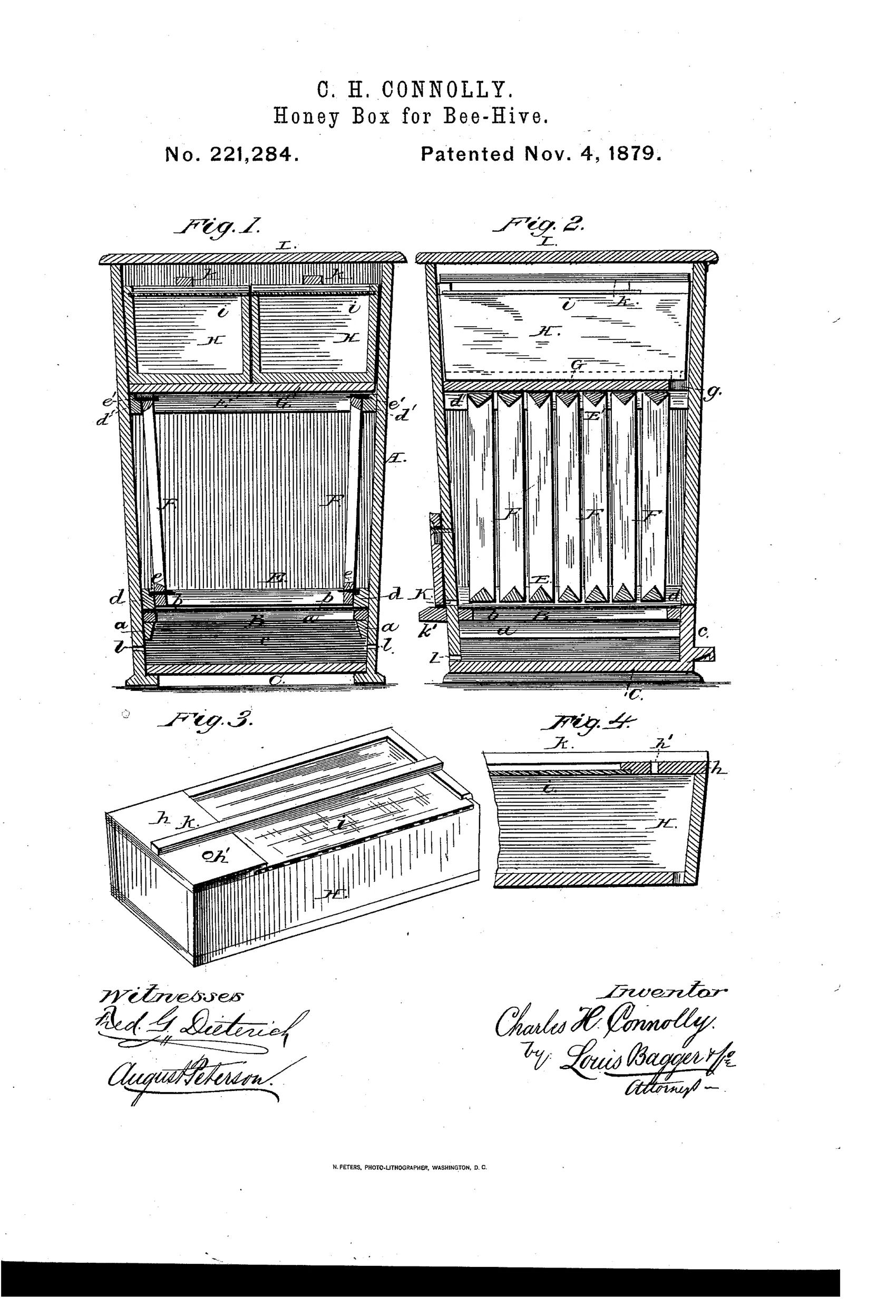
Improved honey-box for a bee-hive
⬡ How it works
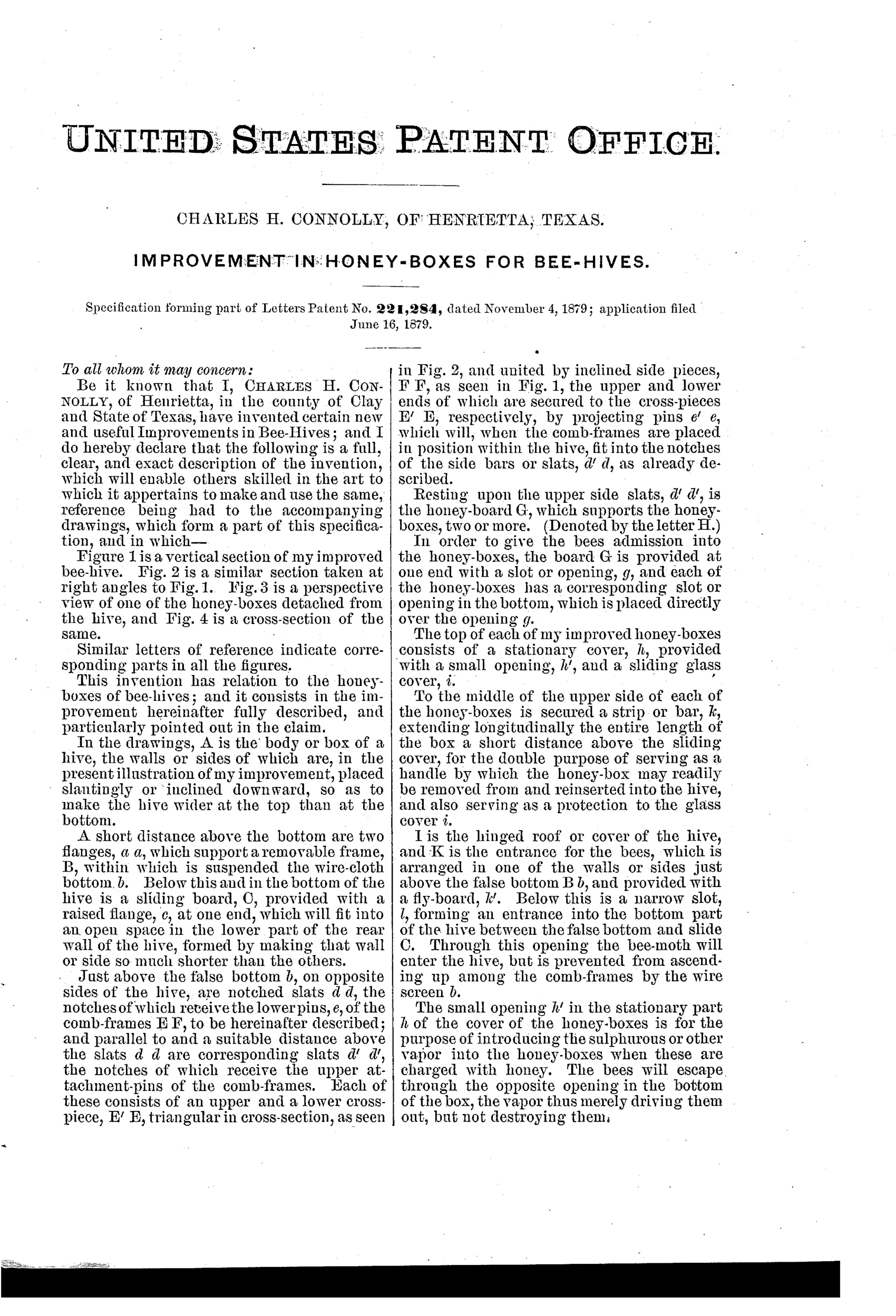
The hive body has slanting sides and holds movable comb-frames supported on notched slats, with a wire-cloth false bottom and sliding board beneath to catch bee-moths. A honey-board with a slot rests above the frames and supports two or more honey-boxes, each having a corresponding slot so bees can pass up into the boxes. Each honey-box has a stationary cover with a small perforation and a transparent sliding glass cover, plus a longitudinal handle bar above the glass. The perforation allows sulphurous vapor to be introduced to drive bees out of the honey-box without killing them, the bees escaping through a matching opening in the bottom of the box.
⬡ What was claimed
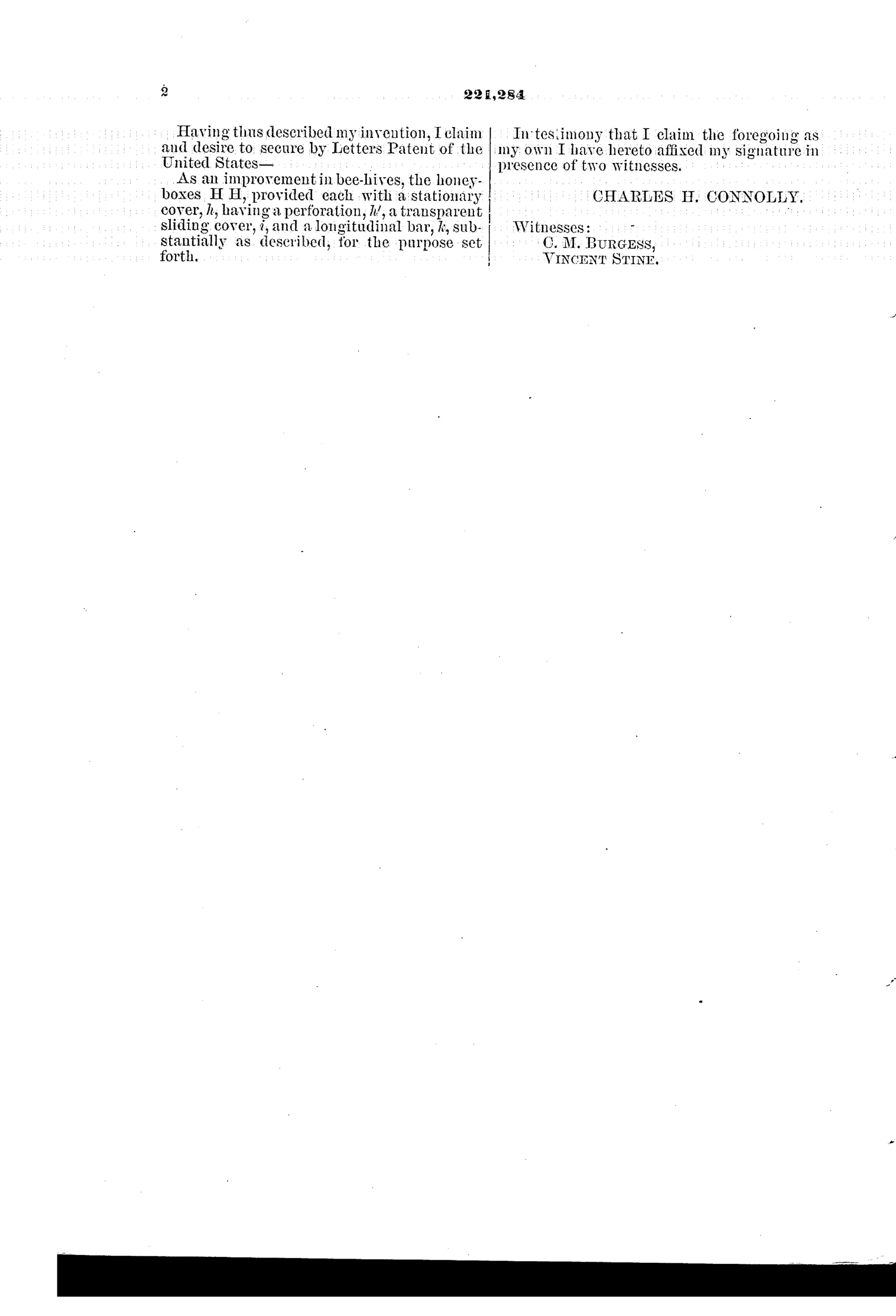
“As an improvement in bee-hives, the honey-boxes H H, provided each with a stationary cover, h, having a perforation, h', a transparent sliding cover, i, and a longitudinal bar, k, substantially as described, for the purpose set forth.”
In plain English: The invention claims honey-boxes for bee-hives that each have a fixed cover with a small vent hole, a sliding glass cover to view inside, and a handle bar on top.
⬡ In the inventor’s words
“The bees will escape through the opposite opening in the bottom of the box, the vapor thus merely driving them out, but not destroying them.”— Charles H. Connolly, from the specification
Paper patent — likely never produced
No evidence this Henrietta, Texas design was manufactured, and the bee-escape soon made its fumigation approach obsolete; a surviving marked box would overturn this.
⬡ Commentary
Connolly's claim is narrower than his drawing suggests. The hive itself — slant-sided body, movable frames on notched slats, wire-cloth false bottom with a sliding moth-catcher board underneath — is standard-issue 1870s equipment, twenty-seven years downstream of Langstroth. What he actually patented is the honey-box on top: a fixed lid with one small perforation, a sliding glass cover for inspection, and a handle bar. The perforation is the point. You puff sulphurous vapor in through the hole, the bees flee out the bottom slot into the hive, and you lift off a box full of comb honey without a single sting or a single dead bee.
That last part matters historically. Sulfuring bees was the old box-hive method of harvest — and it killed the colony. Connolly is using the same fumigant as a persuasion rather than an execution, which shows how the ethics of harvest were shifting. He was chasing the same problem that Porter's spring bee-escape would solve far more elegantly a decade later: no fumes at all, just a one-way door.
The sliding glass cover is a nice practical touch — you can check whether the sections are capped without cracking the box open. But the fumigation scheme is finicky in practice; getting smoke to drive bees downward reliably through one slot takes more cooperation than bees usually offer. A workmanlike dead end, superseded by better escapes.
Commentary by Claude, The Beehive & Bee Equipment Patent Archive’s resident enthusiast