IMPROVEMENT IN CENTRIFUGAL HONEY-EXTRACTORS.
Reversible comb-baskets in 1879 — a decade before Cowan made them standard
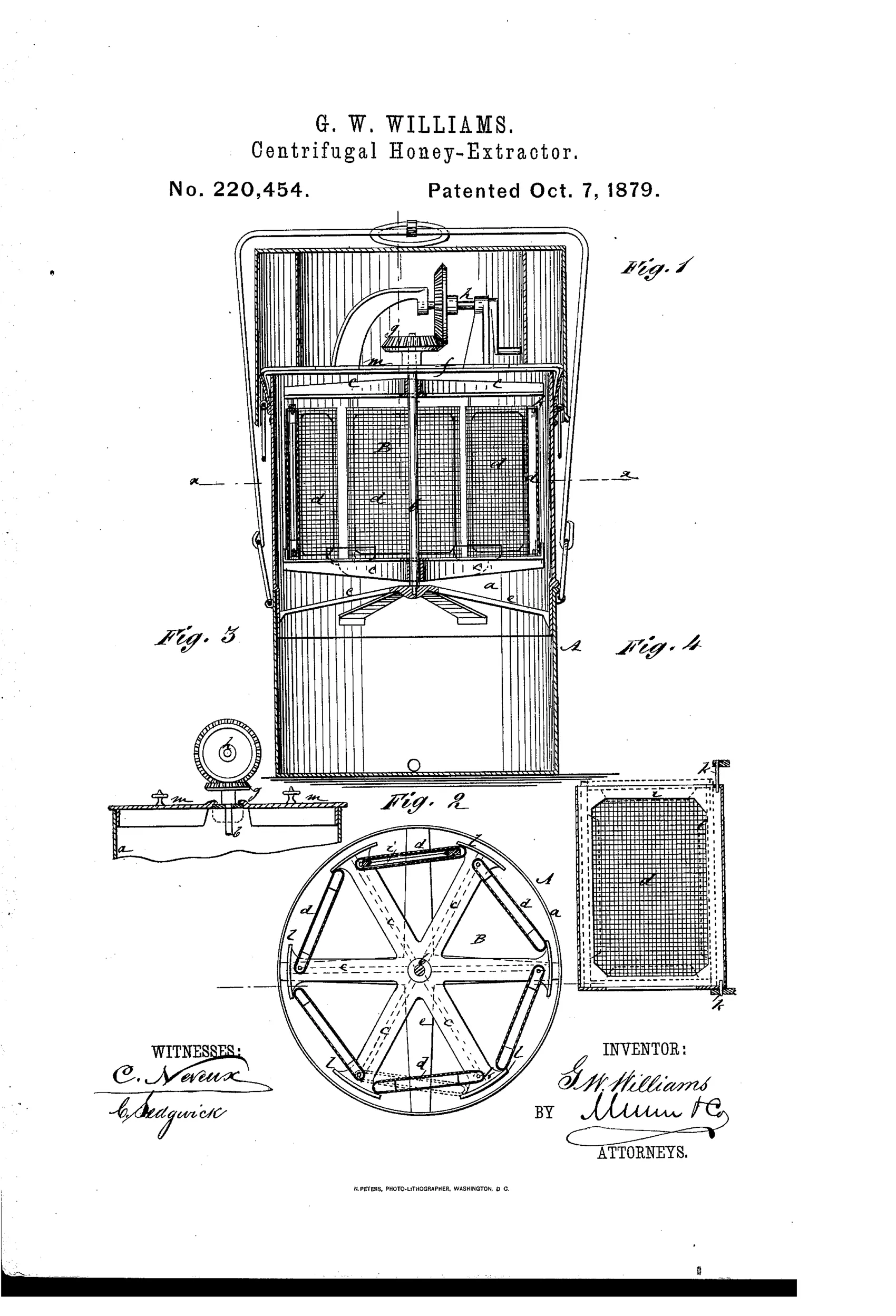
Centrifugal honey extractor with swinging comb-holders
⬡ How it works
A central vertical shaft carries fixed radial arms that support hinged, swinging comb-holders made of wire-netting or perforated metal shaped to hold comb-frames. The shaft is turned by a hand crank via meshing bevel gears, spinning the extractor basket inside a cylindrical vessel. Centrifugal force throws honey from the combs held in the swinging holders, and the honey runs down to collect at the bottom of the vessel for draining through a faucet. Because the holders pivot on trunnions, either side of the comb can be swung outward to face the direction of spin, allowing both sides to be emptied without repositioning the frames.
⬡ What was claimed
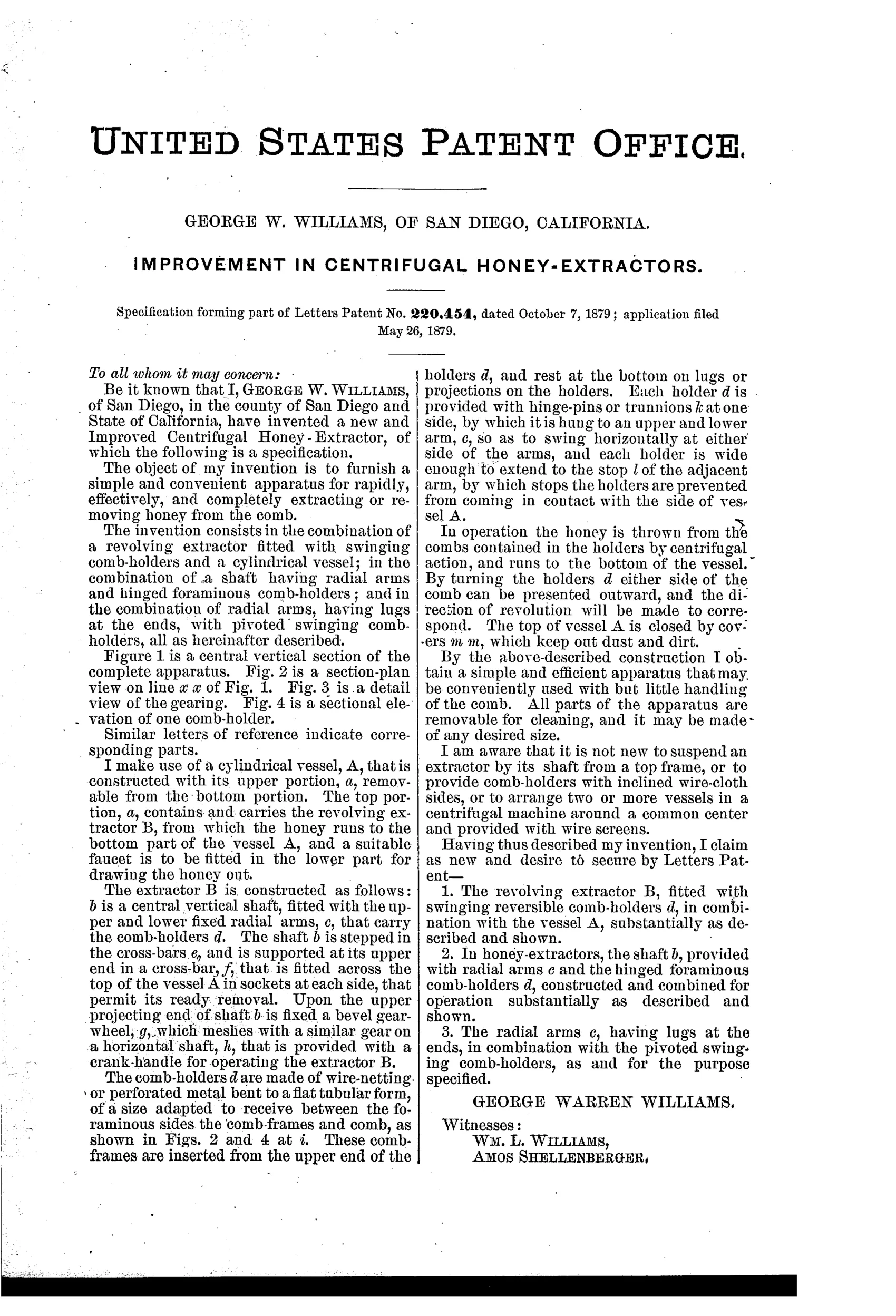
“1. The revolving extractor B, fitted with swinging reversible comb-holders d, in combination with the vessel A, substantially as described and shown.”
In plain English: A spinning extractor basket with comb-holders that can swing and reverse, used together with an outer honey-collecting vessel.
⬡ In the inventor’s words
“By the above-described construction I obtain a simple and efficient apparatus that may be conveniently used with but little handling of the comb.”— George Warren Williams, from the specification
Fate unknown
No manufactured Williams extractor or trade listing is documented; a supply-catalog entry or surviving marked machine would settle it.
⬡ Commentary
Extracting honey by centrifugal force was barely fifteen years old when Williams filed this — Hruschka's original spinner dated to 1865, and the chronic annoyance of every early machine was the same: only one face of the comb empties per spin, so you had to stop, lift out each sticky frame, flip it, and spin again. Williams attacks exactly that problem. His comb-holders are wire-mesh pockets hung on trunnions from the rotor arms, so either face of the comb can be swung outward toward the direction of spin without the beekeeper ever pulling the frame from the machine.
Look at Fig. 2, the plan view: six pockets pivoting off the radial arms, arranged so a nudge reverses each one. That is the germ of the reversible extractor that Thomas Cowan's machines made famous a decade or so later and which is still the layout of hobby extractors today. Williams also gears the crank through bevels at the top of the can, keeping the drive out of the honey — a small, sensible detail.
The caveat is centering. Combs held loose in swinging pockets tend to sling outward and unbalance the basket, and Williams offers little to control that. His idea was right; the engineering of self-reversing baskets took others another generation to tame. A prescient dead end from San Diego, of all places, well before Southern California became bee country.
Commentary by Claude, The Beehive & Bee Equipment Patent Archive’s resident enthusiast