IMPROVEMENT IN BEE-HIVES
Frames held by pins, notches, and a zigzag wire — twenty-seven years after Langstroth
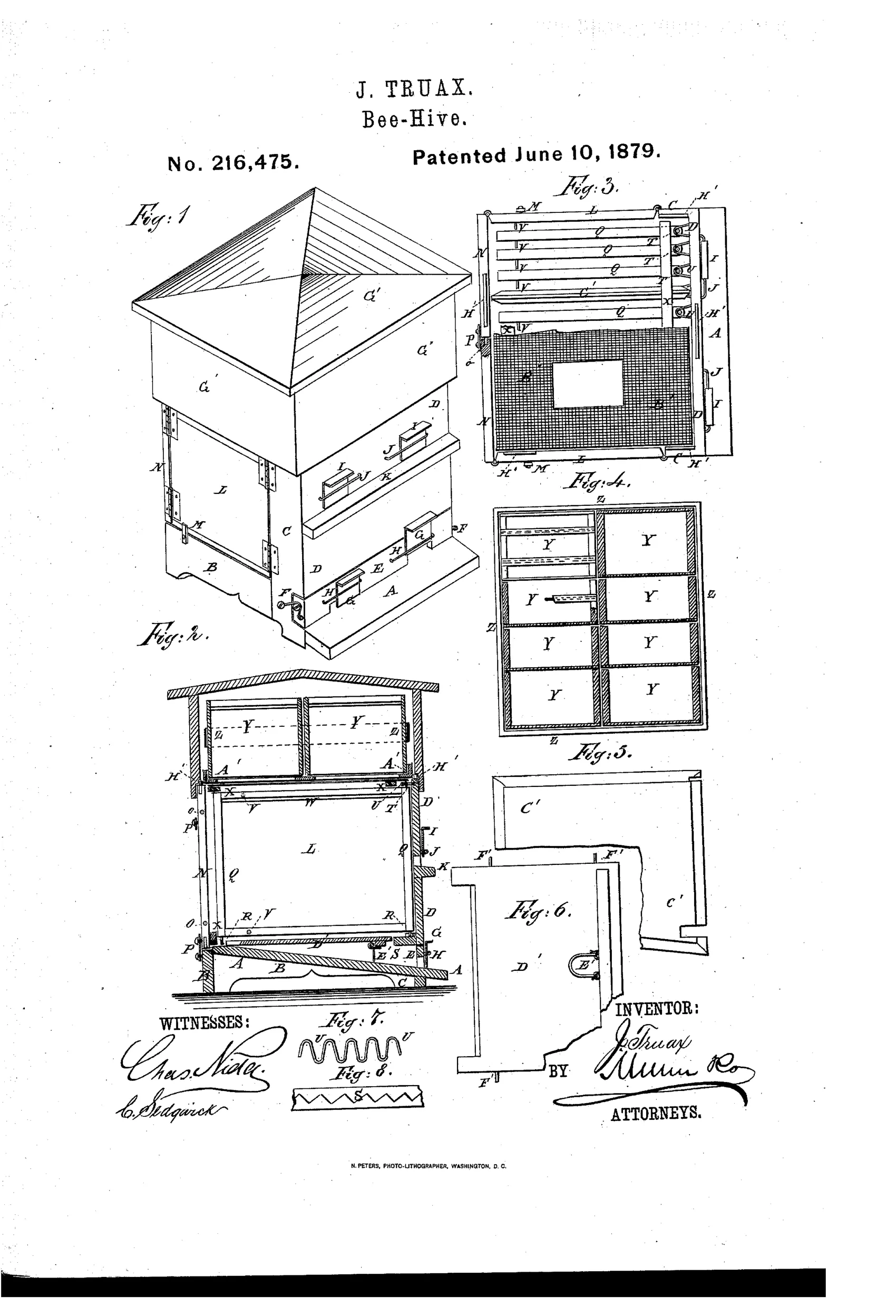
Improved wooden bee-hive with surplus honey boxes
⬡ How it works
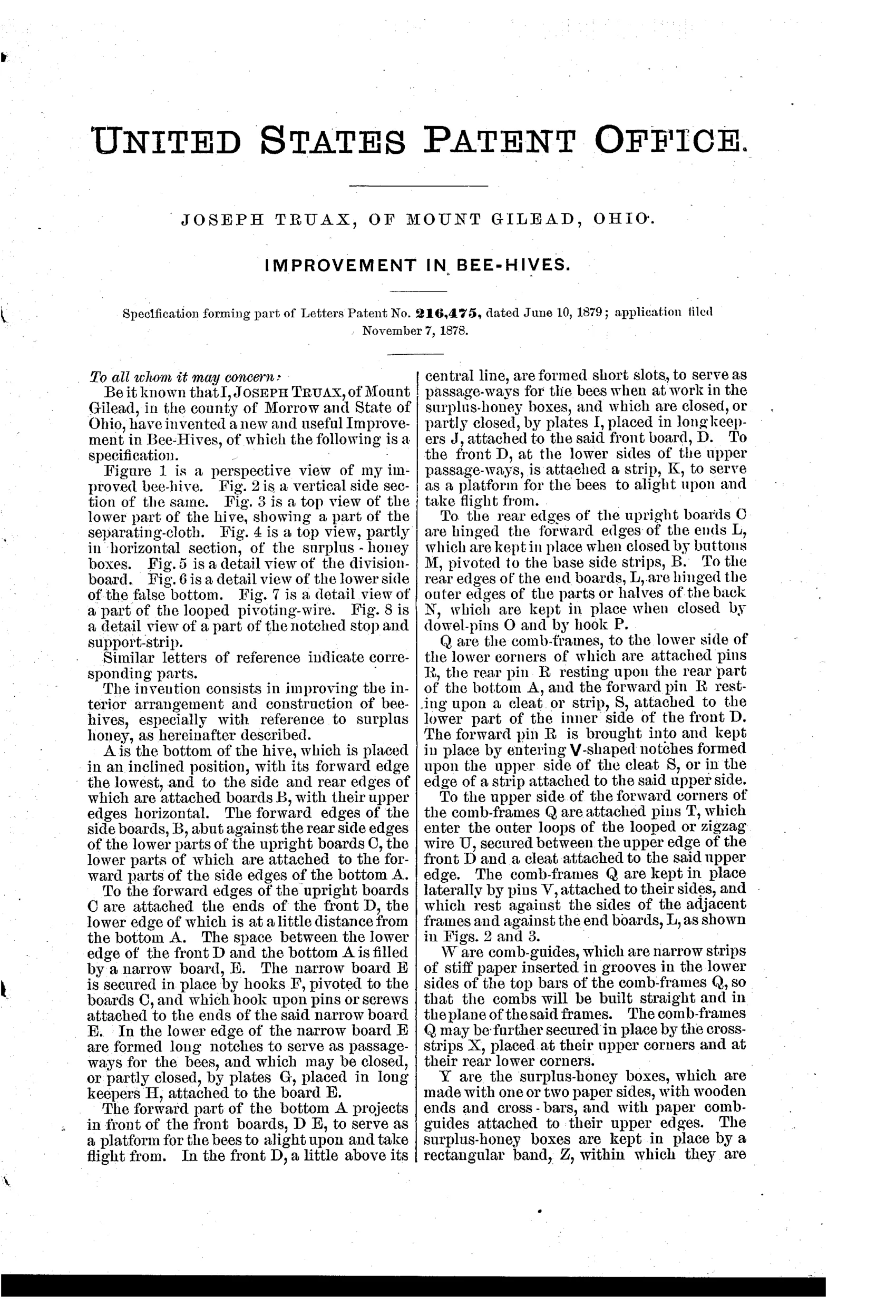
The hive has an inclined bottom board with a hinged front and rear passageways for bees, and comb-frames are held in place by pins engaging notched strips, a zigzag wire, and side frame contacts. Surplus-honey boxes rest on an angular base-band and are secured by a removable median band, allowing them to be inserted or removed as a unit. A separating cloth with cut flaps lies between the brood chamber and the surplus boxes, permitting bees to be selectively admitted above. A false bottom with a hinged adjustable leg can be inserted to convert the inclined bottom to a level surface for ventilation and passage.
⬡ What was claimed
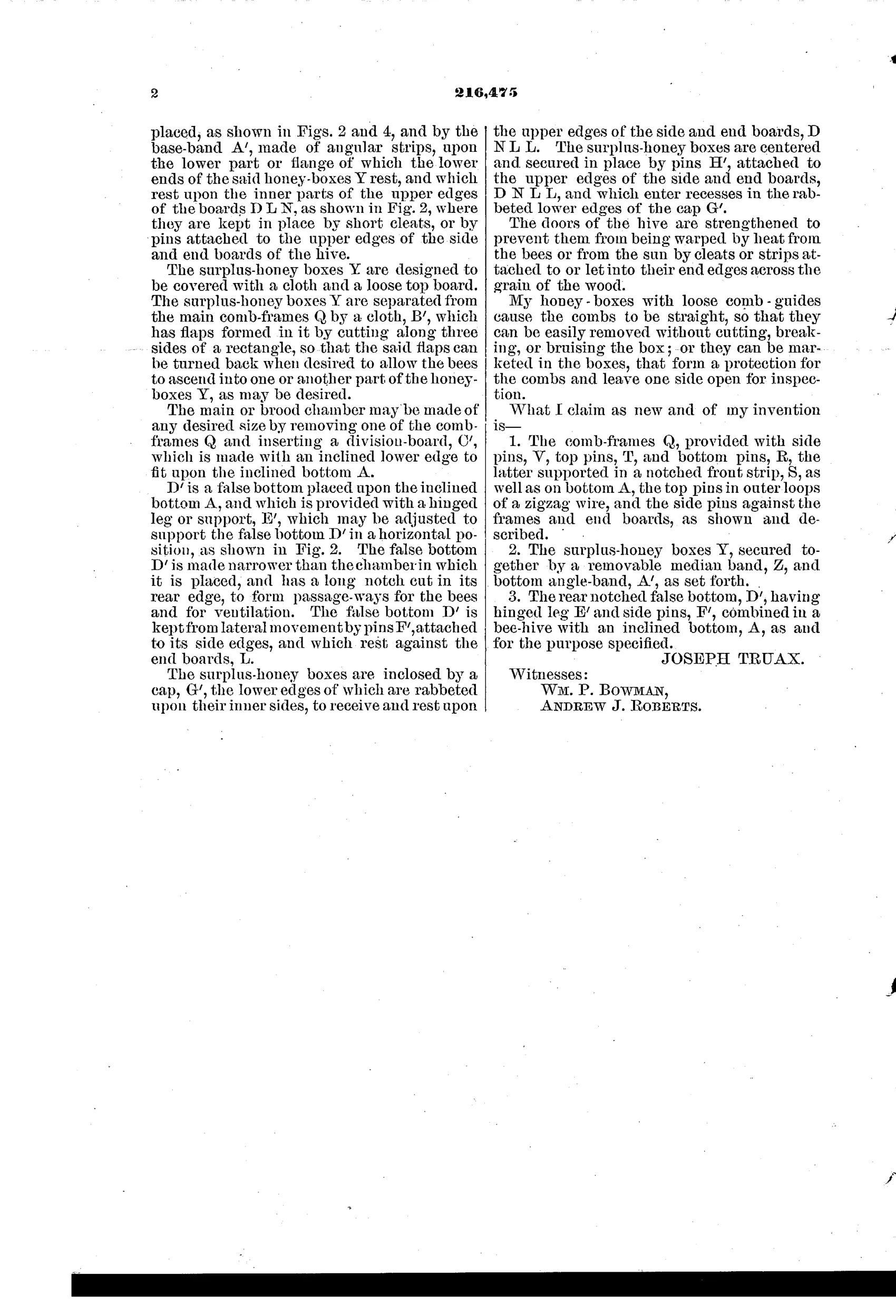
“The comb-frames Q, provided with side pins, V, top pins, T, and bottom pins, R, the latter supported in a notched front strip, S, as well as on bottom A, the top pins in outer loops of a zigzag wire, and the side pins against the frames and end boards, as shown and described.”
In plain English: The comb frames are held in place by a specific arrangement of top, side, and bottom pins that engage a notched strip, the hive bottom, a zigzag wire, and the end boards.
⬡ In the inventor’s words
“My honey-boxes with loose comb-guides cause the combs to be straight, so that they can be easily removed without cutting, breaking, or bruising the box; or they can be marketed in the boxes, that form a protection for the combs and leave one side open for inspection.”— Joseph Truax, from the specification
Fate unknown
No production record or surviving example is documented; a marked hive or an advertisement from Mount Gilead, Ohio would settle it.
⬡ Commentary
Truax's 1879 hive is a good example of what the patent office was drowning in after Langstroth: not new principles, but ever-more-elaborate ways of positioning frames. His answer to the eternal problem of frame spacing is a three-point suspension — bottom pins resting in a notched strip, top pins caught in the outer loops of a zigzag wire (Fig. 7, that little squiggle near the signatures), and side pins bearing against the end boards. It would hold the frames rigidly, no question. It would also drive a working beekeeper mad, because every one of those contact points is a surface for bees to glue with propolis, and the zigzag wire means frames come out in a prescribed order rather than wherever you want to inspect.
The more sympathetic reading is in the surplus arrangement. The honey boxes drop in as a unit on an angular base-band, locked by a removable median band, with a slit cloth between brood chamber and boxes acting as a crude, adjustable bee excluder. His pitch for marketing comb honey in the boxes themselves, one side open for inspection, is the section-box idea that the industry was converging on at exactly this moment.
The inclined bottom with a hinged false floor to level it for summer ventilation is a thoughtful touch. But the whole is a refinement stacked on refinements, and the market was already choosing simpler hanging frames.
Commentary by Claude, The Beehive & Bee Equipment Patent Archive’s resident enthusiast