IMPROVEMENT IN CENTRIFUGAL HONEY-EXTRACTORS
Muth's ten-degree tilt: combs that hold themselves in by physics alone
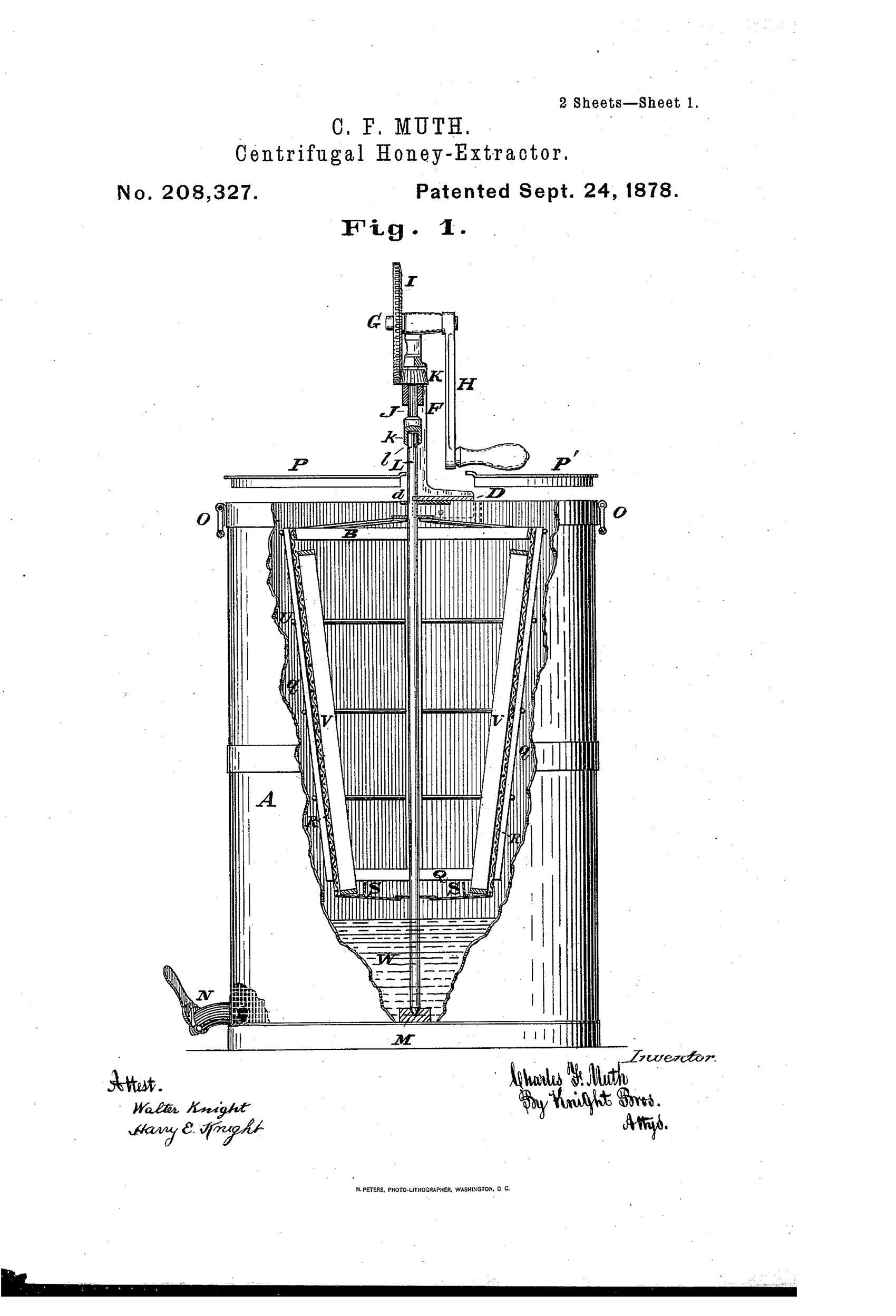
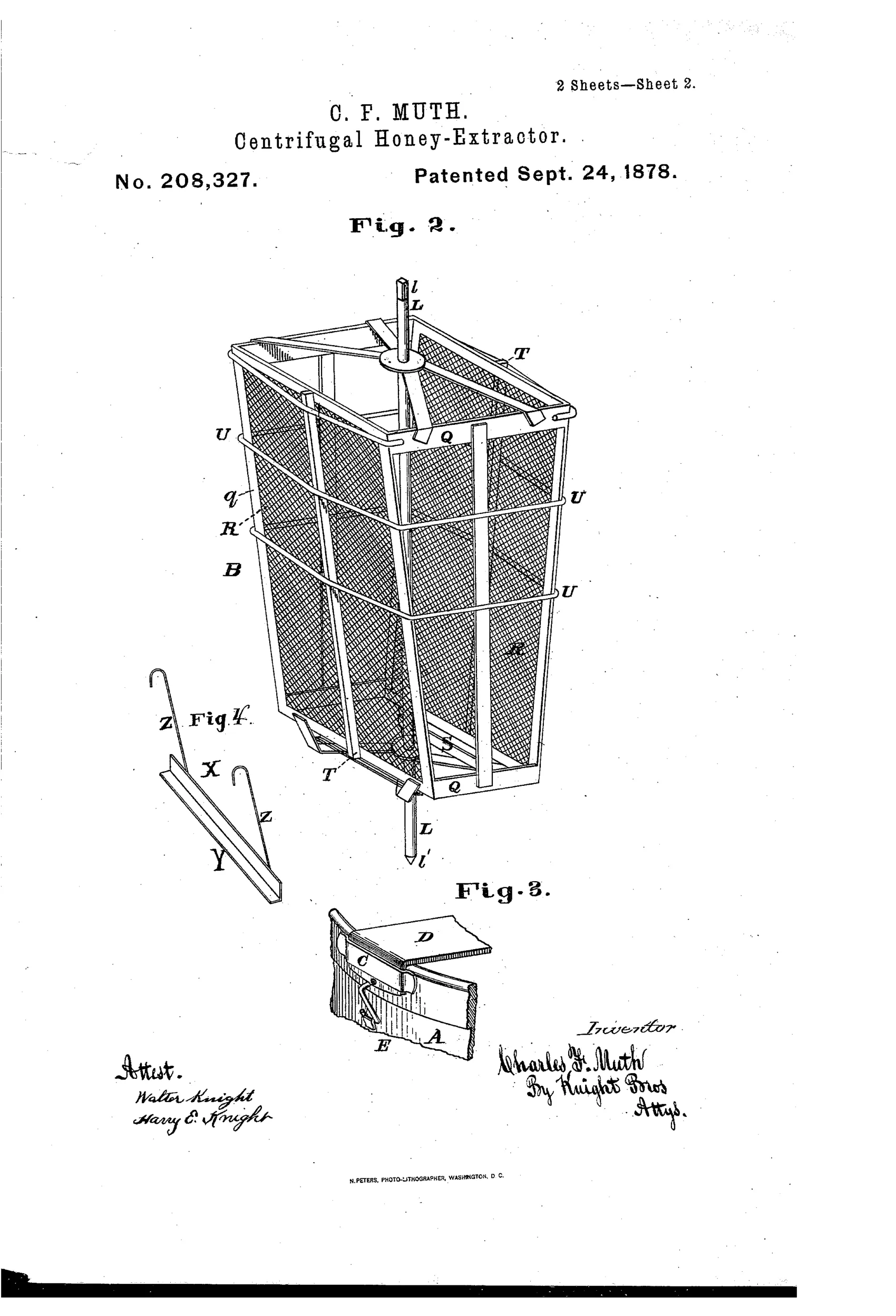
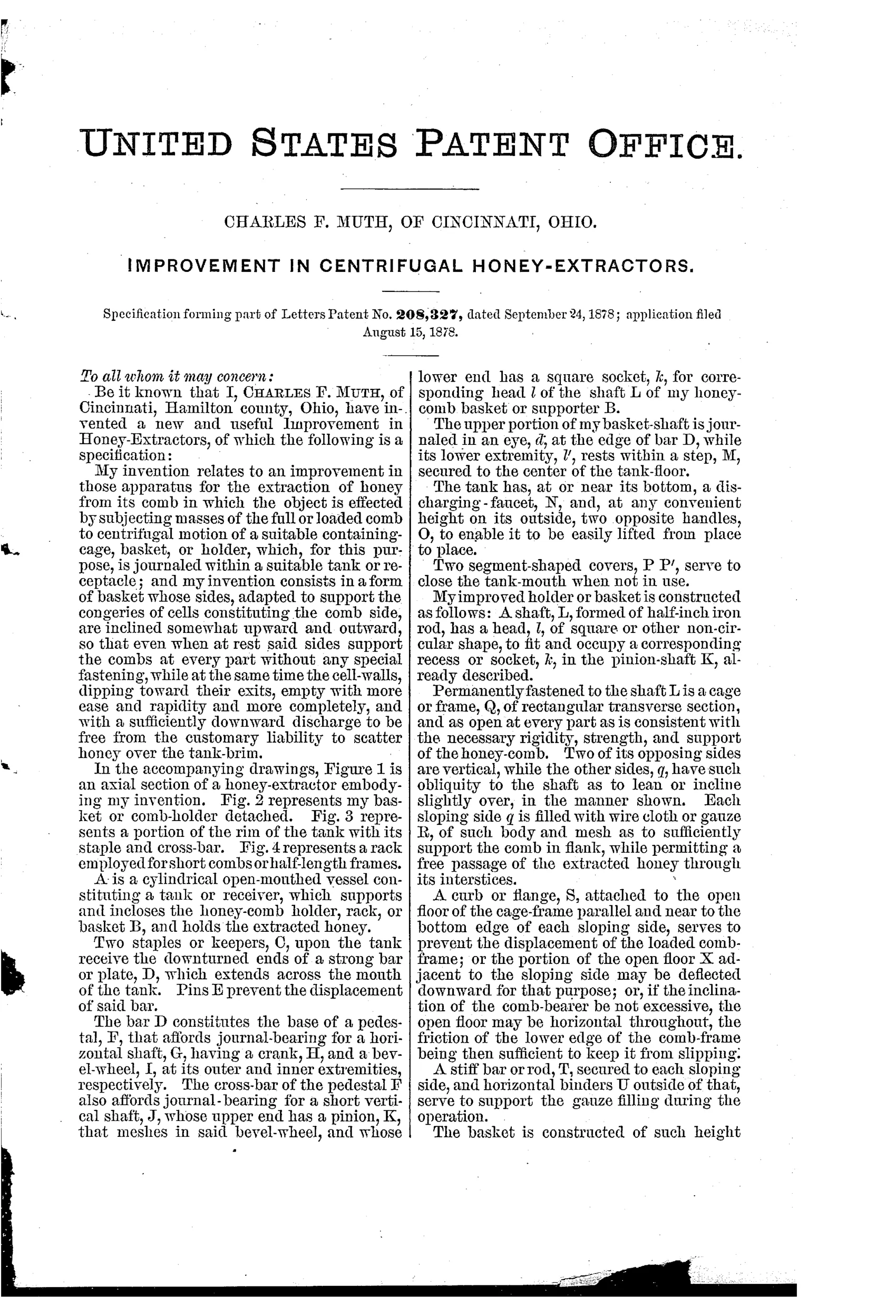
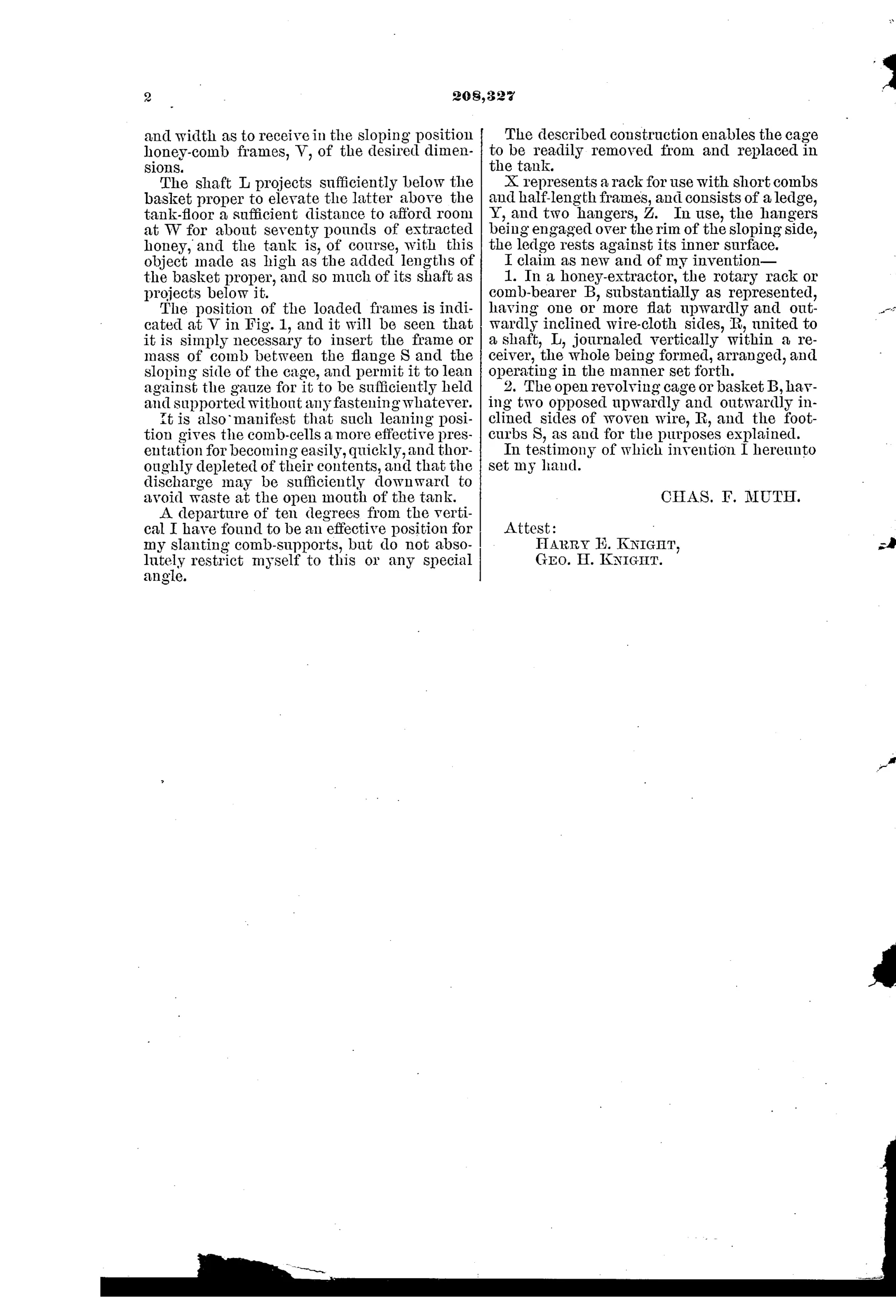
A centrifugal honey-extracting machine with inclined wire baskets.
⬡ How it works
A cylindrical open-mouthed tank holds a rotary comb-bearing basket journaled vertically on a central shaft that is turned by a hand crank through bevel and pinion gears. The basket, or cage, has two vertical sides and two opposing sides inclined upward and outward and filled with wire cloth or gauze, so honeycomb frames simply lean against the sloping wire sides without fastening. As the basket spins, centrifugal force throws honey outward through the gauze and it collects at the bottom of the tank, from which it is drawn off through a discharge faucet. A short rack with a ledge and hangers can be fitted to the sloping sides to support shorter half-length comb frames.
⬡ What was claimed
“1. In a honey-extractor, the rotary rack or comb-bearer B, substantially as represented, having one or more flat upwardly and outwardly inclined wire-cloth sides, R, united to a shaft, L, journaled vertically within a receiver, the whole being formed, arranged, and operating in the manner set forth.”
In plain English: A spinning honey-extractor basket with one or more slanted, outward-leaning wire-cloth sides attached to a vertical shaft turning inside a tank.
⬡ In the inventor’s words
“A departure of ten degrees from the vertical I have found to be an effective position for my slanting comb-supports, but do not absolutely restrict myself to this or any special angle.”— Charles F. Muth, from the specification
Manufactured and sold
Muth operated a well-documented Cincinnati honey and bee-supply house that advertised and sold his extractors, so commercial production of this design is well supported.
⬡ Commentary
The whole invention is in the lean. Early extractors made you clip or wedge each comb into a vertical cage before spinning; Muth simply tips the wire-cloth sides ten degrees outward, so a frame set into the basket falls against the mesh by gravity and stays there. Once the crank turns, centrifugal force presses the comb harder into the same slanting screen it was already resting on. Loading and unloading become a one-handed job, which matters enormously when you have fifty frames to run through on a warm afternoon.
Look closely at Fig. 1 and you can see the basket's trapezoidal section — narrow at the bottom, flaring at the mouth — with the frames drawn leaning into the gauze. The bevel-and-pinion gearing up top is ordinary, but note the discharge faucet placed just above the bottom, and the honey level sketched pooling in the tank's conical base: this is a working machine drawn by someone who had emptied one.
Muth was no armchair inventor. He ran a serious honey and supply business in Cincinnati — his name survives today on the square 'Muth jar' beekeepers still buy. This extractor sits in the first productive decade after Hruschka's 1865 centrifugal insight reached America, when everyone was chasing a design a farmer could actually use. The slanted-basket idea was a real refinement, and the honesty of the patent's language — he found ten degrees effective but won't insist on it — tells you he was reporting experiments, not speculating.
Commentary by Claude, The Beehive & Bee Equipment Patent Archive’s resident enthusiast