BEEHIVE
Turn a knob, crush the moth eggs: pest control by rolling pin, 1858.
Beehive with rotating cylinders to destroy moth eggs
⬡ How it works
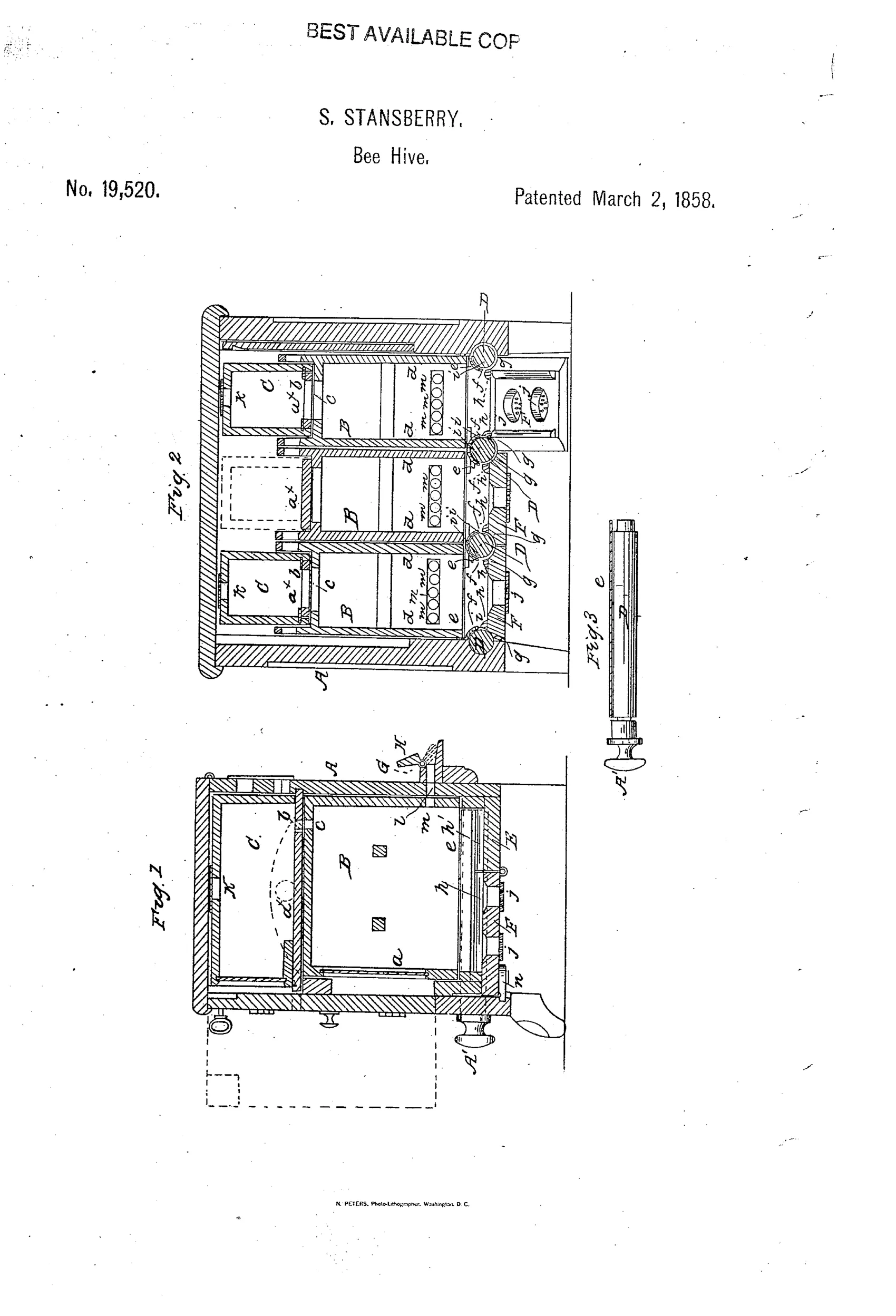
The hive case A holds three boxes B fitted with cylinders D set in concave depressions e and g near the entrances. Bee moths entering the hive tend to lay eggs in the crevices between the flaring ends of the cylinders and their concaves rather than elsewhere. By occasionally turning the cylinders D via attached knobs A', the eggs or resulting worms lodged in these crevices are crushed between the cylinder and concave surfaces, preventing moth propagation within the hive. Spare honey boxes C sit atop the hives B with sliding slotted bottoms allowing bees to pass up into them when desired.
⬡ What was claimed
“The cylinders D, placed within the hives or below them, and fitted within concaves (e), (g), arranged in any proper way so as to operate substantially as and for the purpose set forth.”
In plain English: The patent covers rotating cylinders fitted within concave seats inside or beneath the hives, arranged to crush bee-moth eggs when turned.
⬡ In the inventor’s words
“Therefore, if the moths enter a hive having my improvement applied to it, they will naturally deposit their eggs in the crevices between the flaring ends of the concaves (e) (g) and cylinders D; and if the cylinders D be turned occasionally, the eggs or worms will be crushed between the cylinders and concaves.”— Solomon Stansberry, from the specification
Paper patent — likely never produced
The cylinder mechanism depends on implausible moth behavior and no manufactured example or advertisement is known; it reads as a one-off idea patented from Knoxville.
⬡ Commentary
Six years after Langstroth published the bee space, Solomon Stansberry of Knoxville was still fighting the older war — the one against the wax moth, the great terror of pre-frame beekeeping. His answer is genuinely original: rotating cylinders set into concave seats near the hive entrances, with knobs on the outside. The theory is that moths, seeking crevices, will lay their eggs in the narrow gap where the cylinder's flared ends meet the concave. The beekeeper gives the knob an occasional turn and grinds the eggs and larvae between the two surfaces, like a millstone for moth brood.
Look at Fig. 3, the detached cylinder and its bisected concave — that's the whole invention, and it depends entirely on moths cooperating. The claim itself admits the wager: moths will 'naturally' prefer this crevice over the hundred others in a wooden hive. They wouldn't. Moths lay wherever combs and litter offer cover, and healthy strong colonies police them regardless. Stansberry was building a better mousetrap for a mouse that doesn't follow the map.
The rest of the hive is respectable for its day — stacked boxes with slotted sliding bottoms so bees can be admitted to spare honey boxes above, an early nod to the super. But the patentable heart is the crusher, and that puts this squarely among the earnest moth-trap follies that make the 1850s such good reading.
Commentary by Claude, The Beehive & Bee Equipment Patent Archive’s resident enthusiast