IMPROVEMENT IN BEE-HIVES
A hive patent that spends most of its claims on the jigs for building it
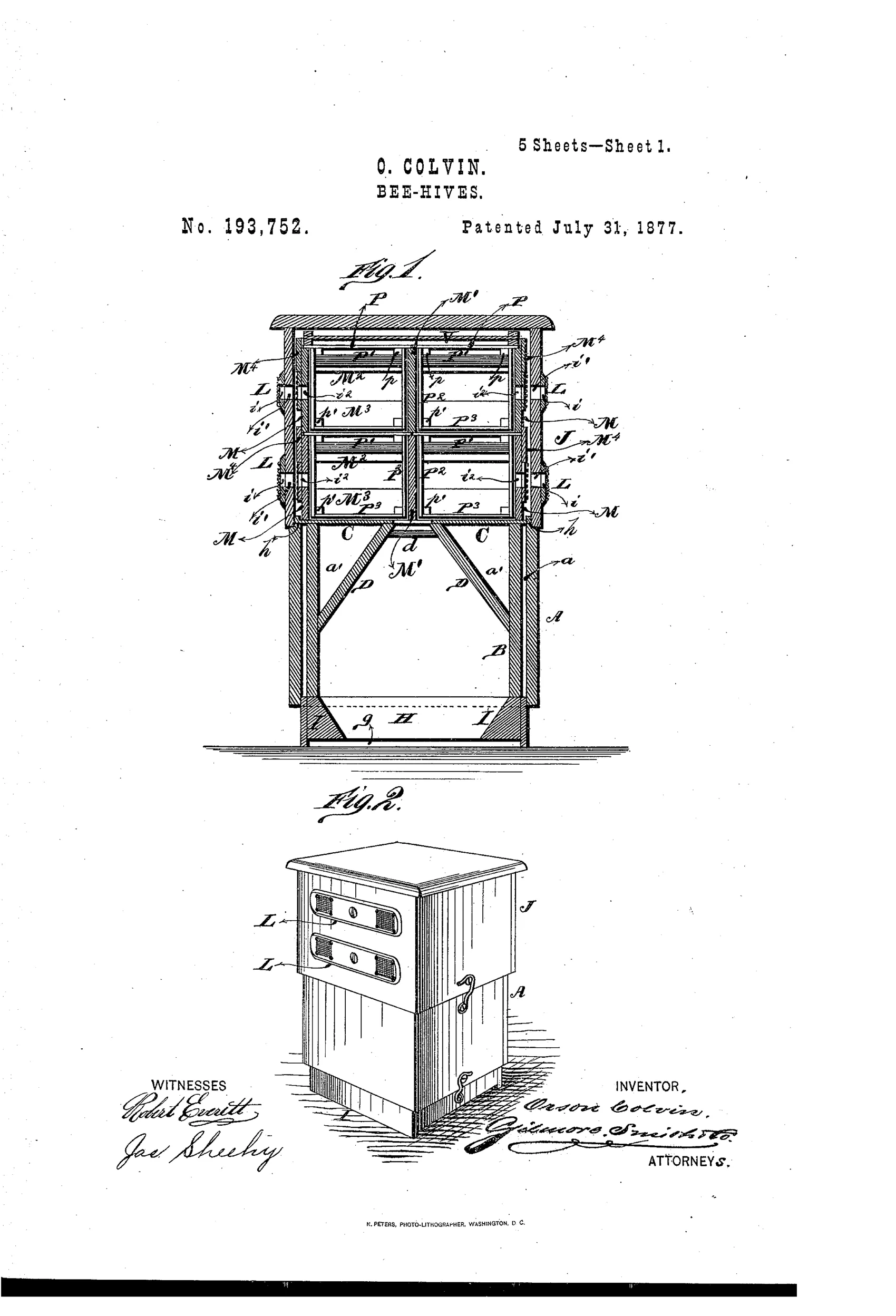
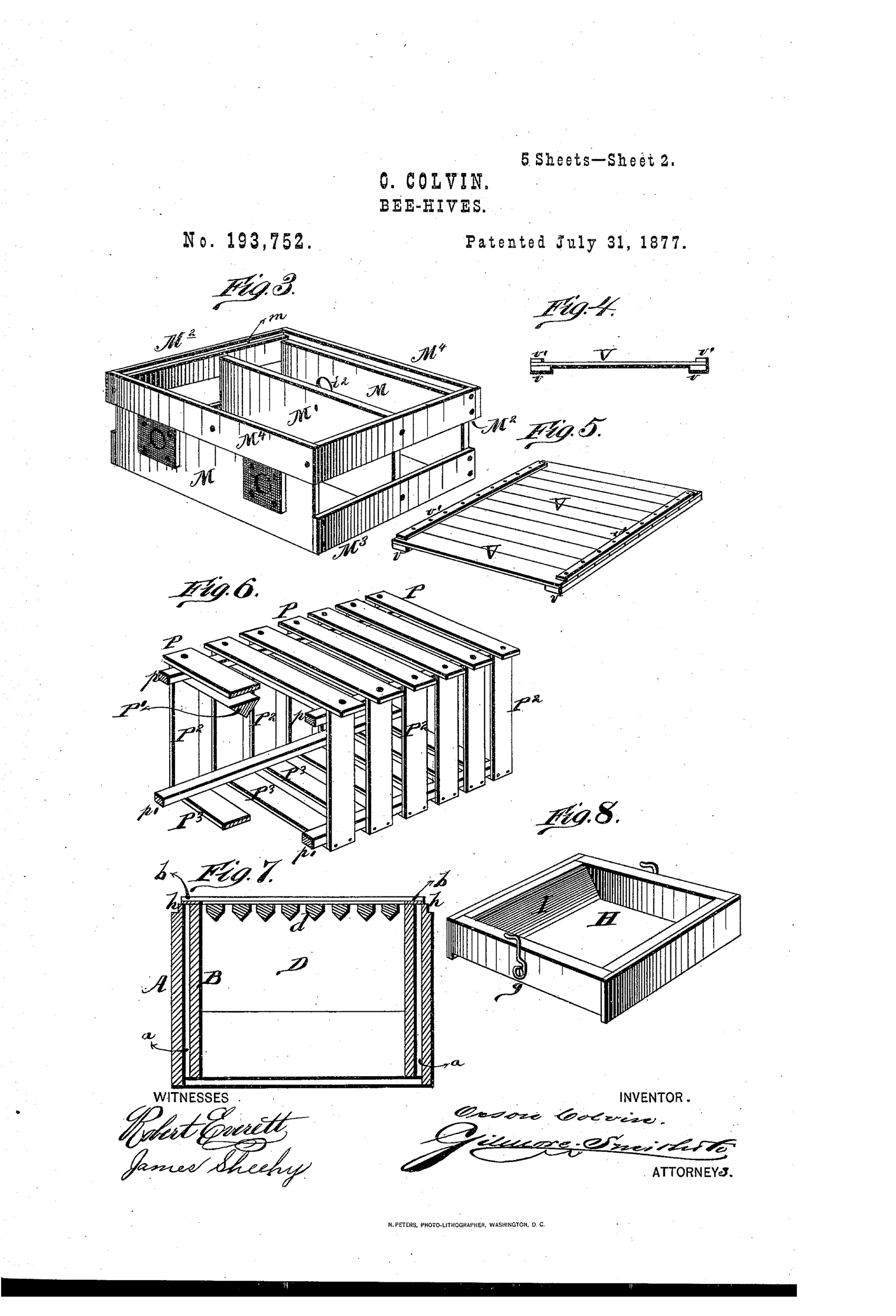
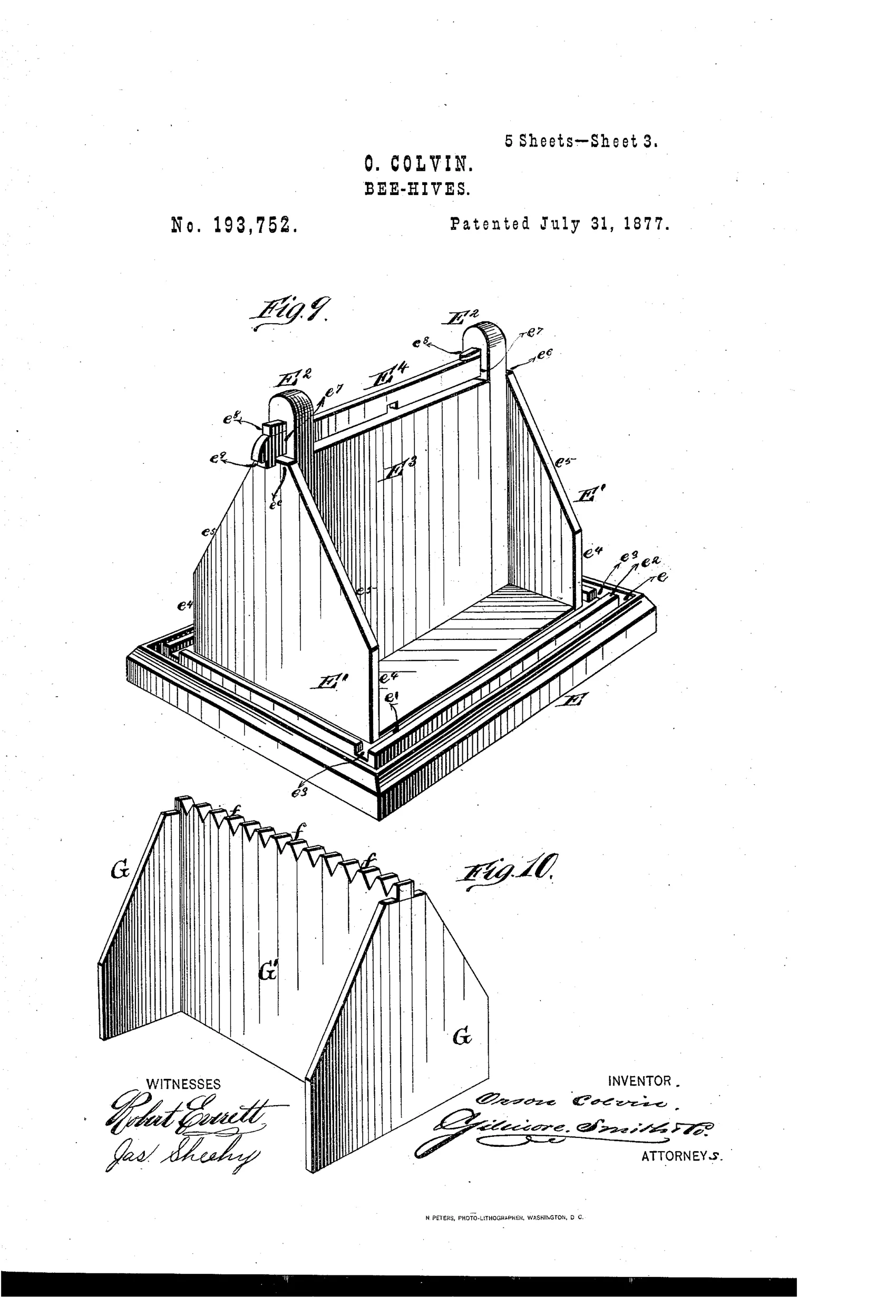
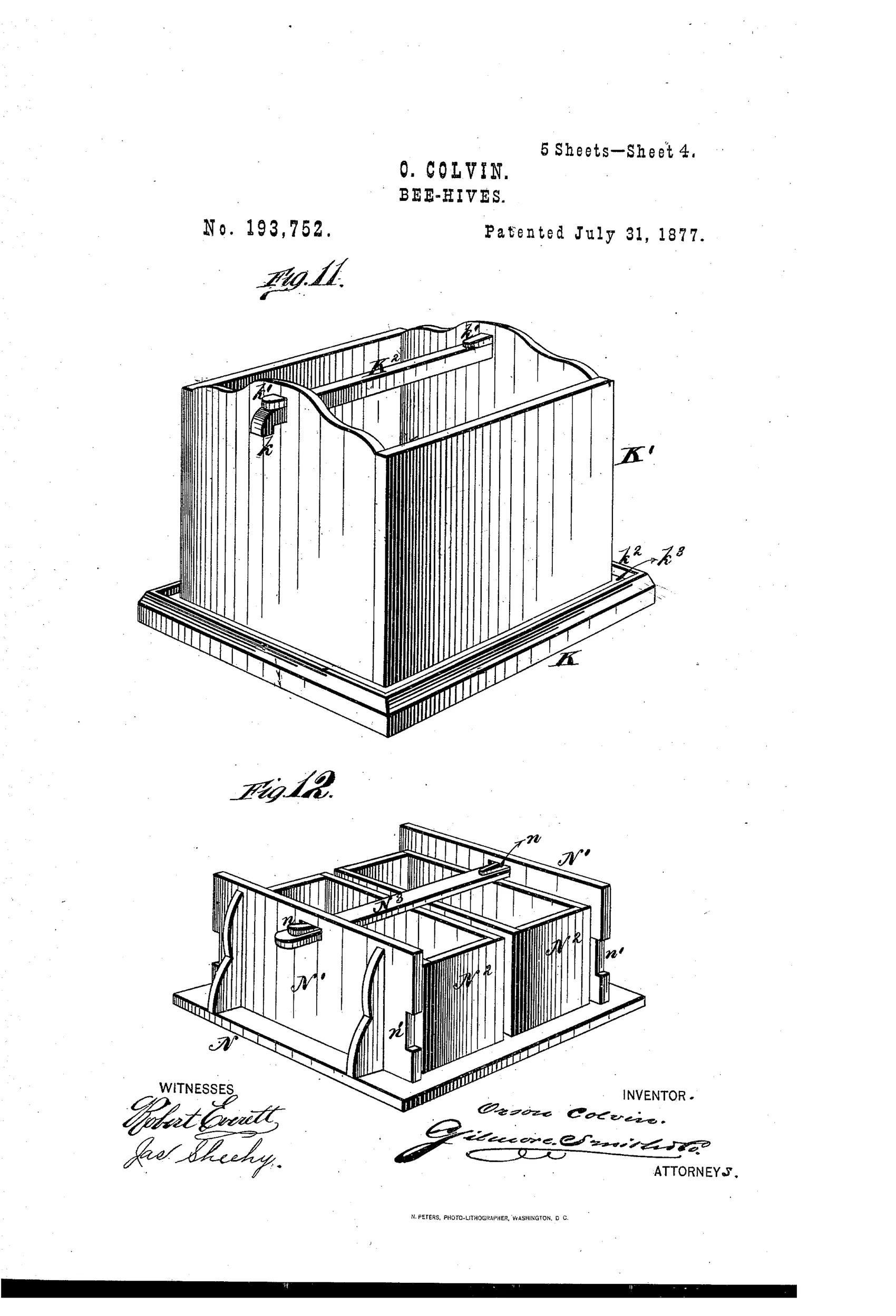
A sectional wooden bee-hive with removable honey-boxes
⬡ How it works
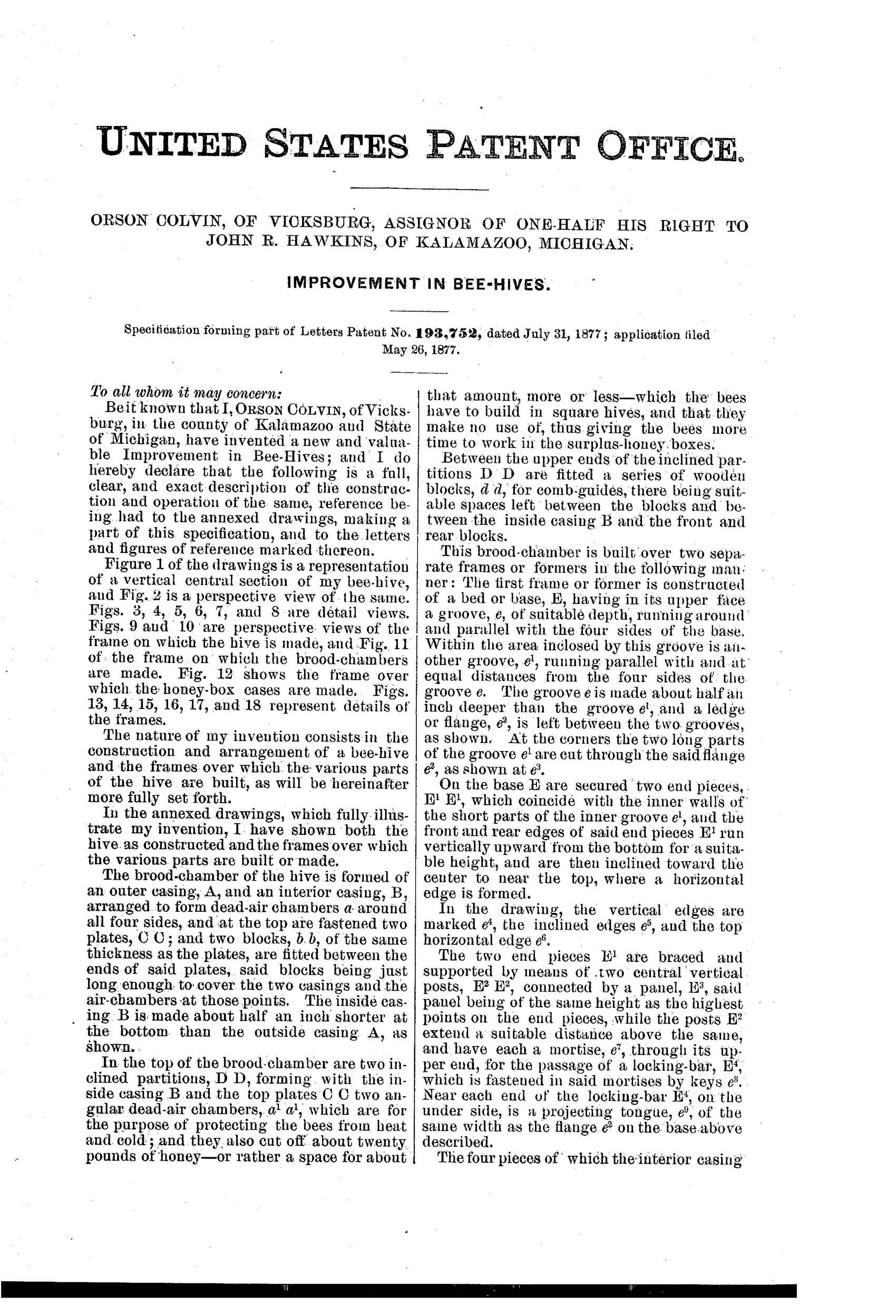
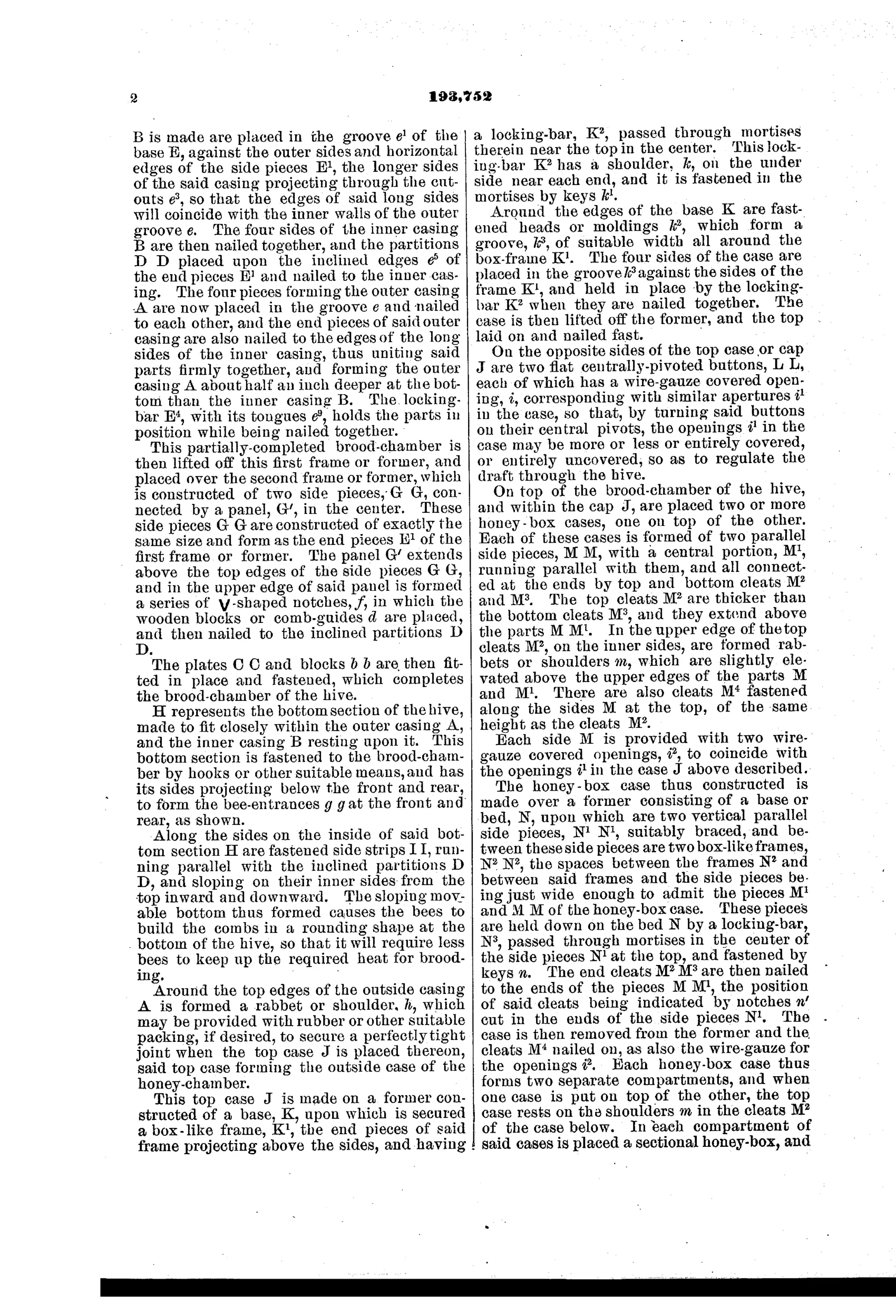
The hive has an outer casing and inner casing forming dead-air chambers around the brood chamber for temperature protection. Inclined partitions with comb-guide blocks form the top of the brood chamber, and a movable sloping bottom causes bees to build rounded combs requiring less heat. Two or more sectional honey-box cases, each divided into compartments by comb-guided top and bottom bars, stack on top of the brood chamber inside a removable cap, with wire-gauze covered ventilation openings regulated by pivoting buttons. The various parts—brood chamber, honey-box cases, and sectional honey-boxes—are each built up over separate wooden forms or formers with grooves, ribs, and locking-bars that hold pieces in place for nailing, after which the completed part is lifted off the former.
⬡ What was claimed
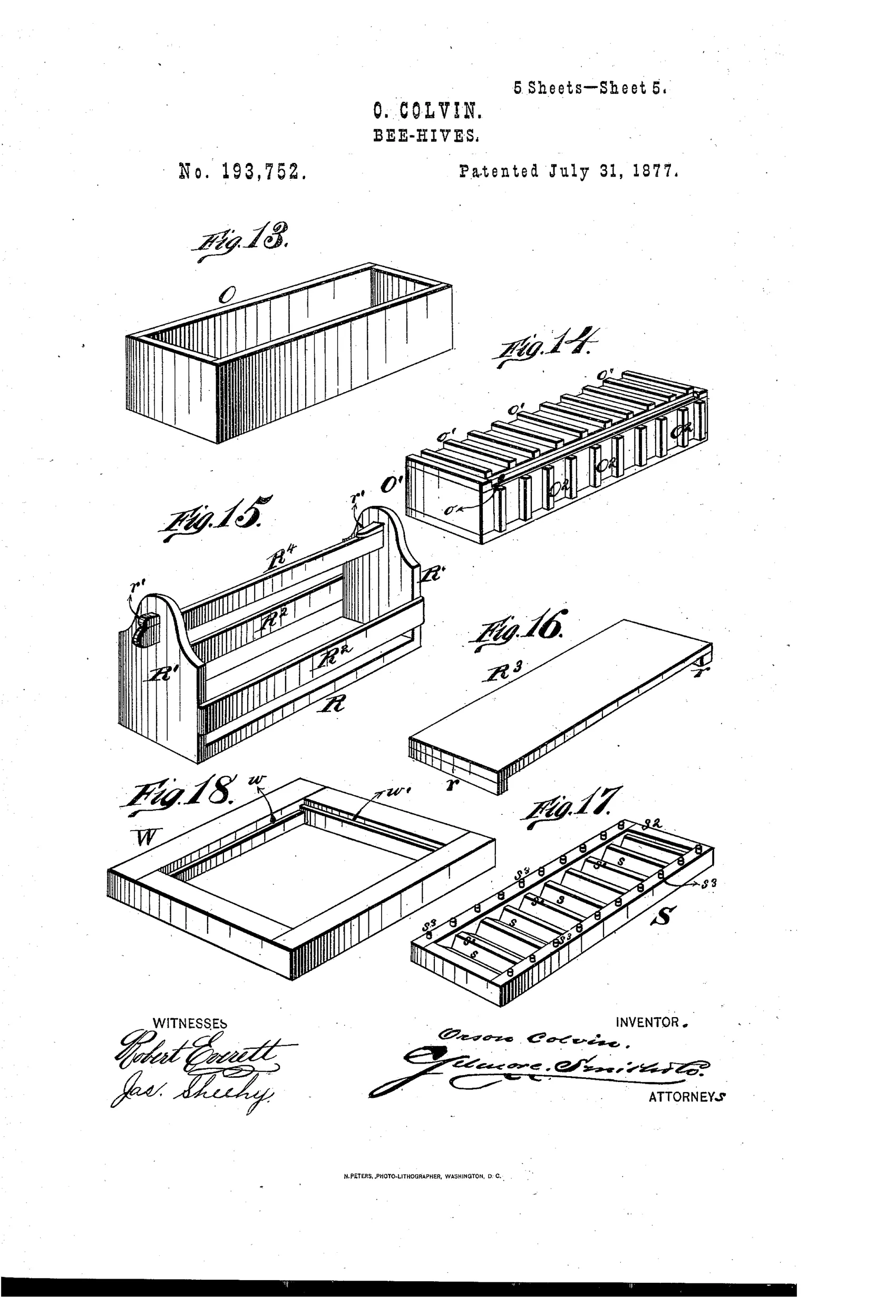
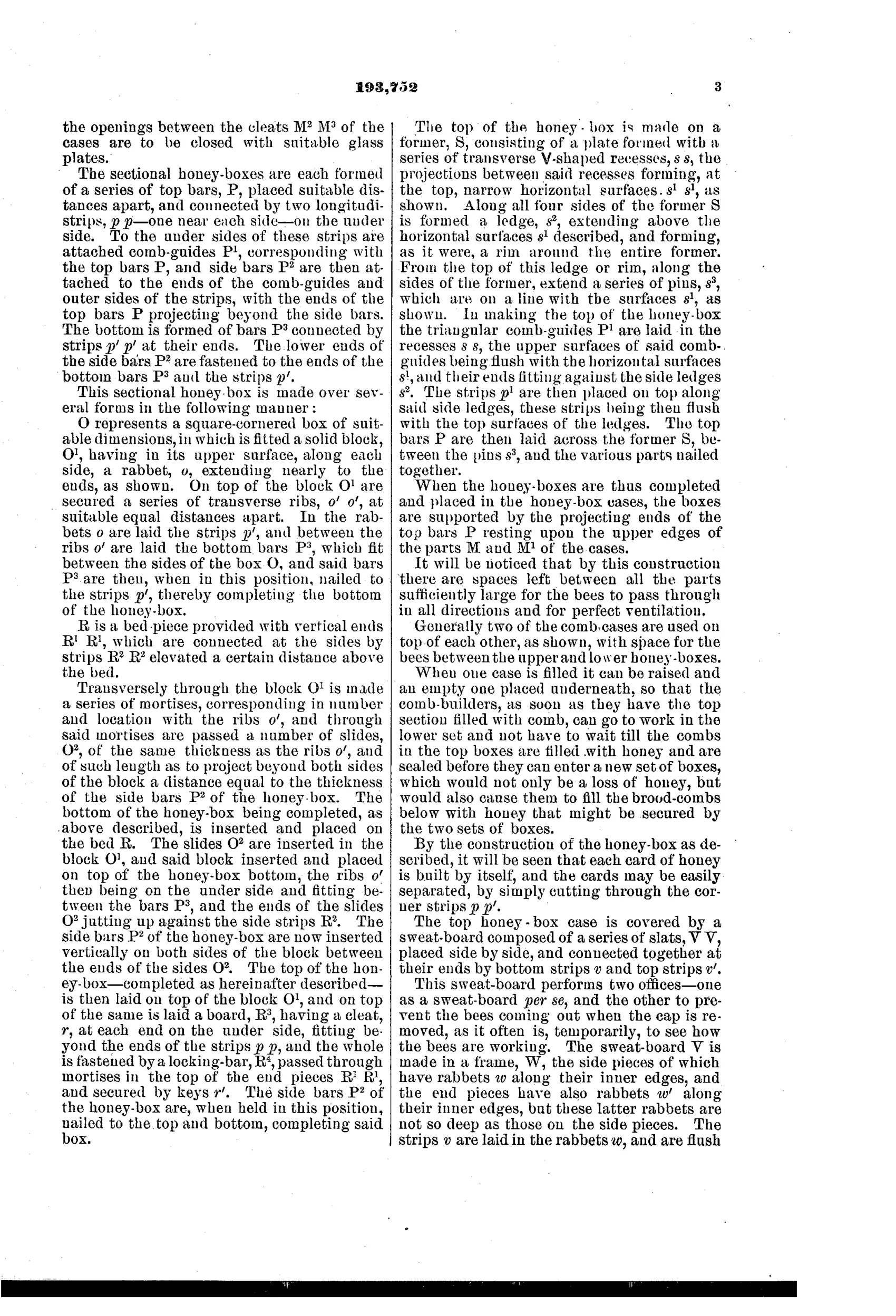
“O represents a square-cornered box of suitable dimensions, in which is fitted a solid block, O1, having in its upper surface, along each side, a rabbet, o, extending nearly to the ends, as shown. On top of the block O1 are secured a series of transverse ribs, o' o', at suitable equal distances apart. In the rabbets o are laid the strips p1, and between the ribs o' are laid the bottom bars P3, which fit between the sides of the box O, and said bars P3 are then, when in this position, nailed to the strips p1, thereby completing the bottom of the honey-box.”
In plain English: A form consisting of a box holding a ribbed block is used to hold the honey-box's side strips and bottom bars in place while they are nailed together to form the honey-box bottom.
⬡ In the inventor’s words
“The sloping movable bottom thus formed causes the bees to build the combs in a rounding shape at the bottom of the hive, so that it will require less bees to keep up the required heat for brooding.”— Orson Colvin, from the specification
Fate unknown
The assigned half-interest hints at commercial intent, but no marked Colvin hive or advertisement is documented; a surviving specimen or Kalamazoo trade listing would settle it.
⬡ Commentary
Colvin's hive itself is a familiar 1870s specimen: double walls with dead-air insulation, stacked sectional honey-box cases under a removable cap, wire-gauze vents with pivoting buttons. What makes the patent unusual is where the ink goes. Of eighteen figures, roughly half depict not the hive but the wooden formers — ribbed blocks, rabbeted boxes, locking cleats — over which each part is assembled and nailed before being lifted off. This is really a manufacturing patent wearing a bee-hive title. Colvin was thinking about how to make many identical hives cheaply, which puts him closer in spirit to the Root and Dadant supply houses than to the palace-hive dreamers.
The apicultural ideas are shakier. The sloping movable bottom that supposedly coaxes bees into 'rounding' combs so fewer bees can hold brood heat is folk thermodynamics; bees cluster to regulate temperature and are indifferent to the flourish. And note what's absent from Fig. 1: no proper movable frames in the Langstroth sense, just comb-guide blocks under inclined partitions. Twenty-five years after US 9,300, that's a step sideways.
Still, the half-interest assigned to a Kalamazoo backer suggests someone intended real production, and the jig-based construction would genuinely speed a small shop. The tooling was the honest invention here, even if the hive it built was already behind the times.
Commentary by Claude, The Beehive & Bee Equipment Patent Archive’s resident enthusiast