IMPROVEMENT IN BEE-HIVING APPARATUS
A mousetrap for swarms: the bees' own weight springs the latch
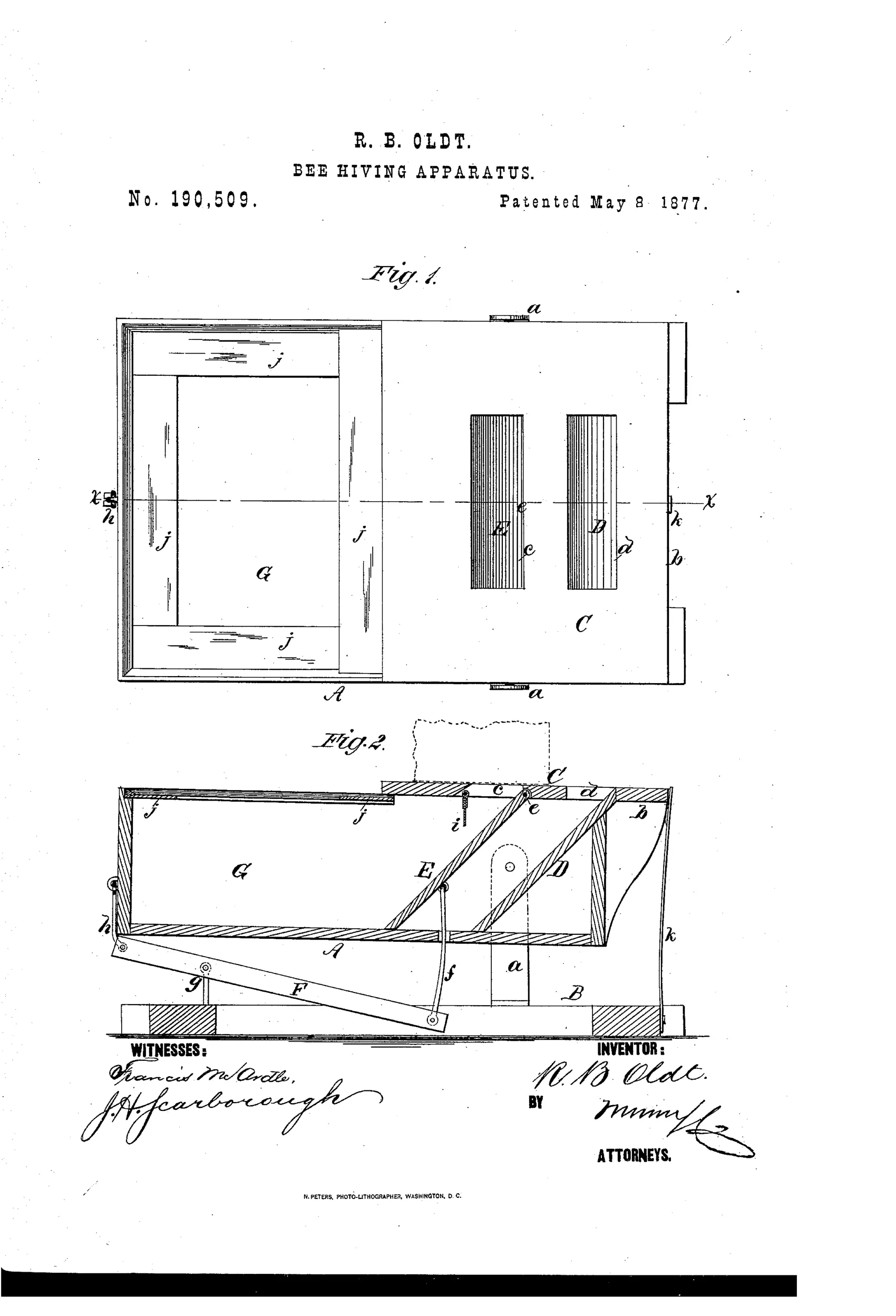
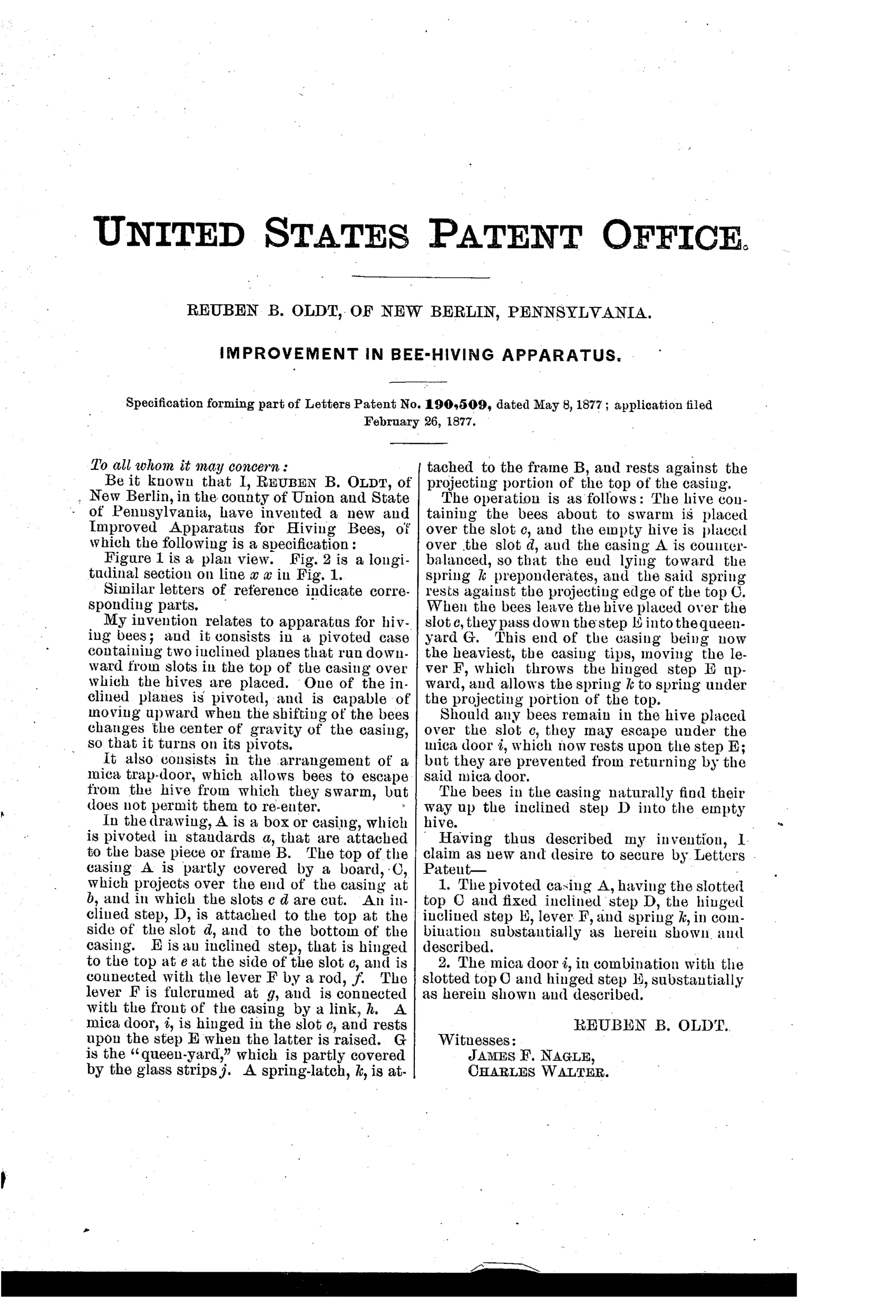
Self-tipping swarm-catching apparatus for beehives
⬡ How it works
A pivoted casing is mounted on a base frame so that it can tip on its pivots as weight shifts inside it. Two inclined steps lead down from slots in a slotted top board into a central queen-yard, one step fixed and one hinged and linked by a rod to a fulcrumed lever. When swarming bees enter over the hinged step, their weight tips the casing, which throws the lever and raises the hinged step so a spring-latch snaps into place beneath the projecting top, sealing that entrance while a mica trap-door allows lingering bees to exit but not re-enter, and the bees then move up the fixed incline into an empty hive placed over the other slot.
⬡ What was claimed
“The pivoted casing A, having the slotted top C and fixed inclined step D, the hinged inclined step E, lever F, and spring k, in combination substantially as herein shown and described.”
In plain English: A tipping box with a slotted top, one fixed ramp and one hinged ramp connected to a lever and spring, all working together as described.
⬡ In the inventor’s words
“This end of the casing being now the heaviest, the casing tips, moving the lever F, which throws the hinged step E upward, and allows the spring k to spring under the projecting portion of the top.”— Reuben B. Oldt, from the specification
Paper patent — likely never produced
The finicky weight-balanced trigger and the absence of any known commercial example or catalog listing make production beyond a prototype implausible.
⬡ Commentary
Reuben Oldt of New Berlin, Pennsylvania, built what amounts to a bee-powered mousetrap. The whole casing sits on pivots, balanced like a scale. When a swarm pours in over the hinged ramp, a few ounces of clustered bees is enough to tip the box; the tip throws the lever F, the ramp swings up, and a spring latch snaps closed under the projecting top. The bees have sealed their own door. From there a fixed incline leads them upward into an empty hive set over the other slot — bees climb toward light and height, so the geometry is sound. A mica trap-door works as a one-way valve for stragglers.
Look at Fig. 2 and you can see the balance problem the drawing quietly admits: the long casing G on the left is counterweighted against the trap end, and the lever pivots off the base frame F below. This has to be tuned finely enough that a swarm trips it but a summer breeze or a curious raccoon doesn't. That tuning, done outdoors in weather, is where I suspect the idea meets its trouble.
The 1870s were thick with swarm-catching schemes because a lost swarm was lost honey and lost bees. Most were nets on poles or decoy boxes. Oldt's is more ambitious than most — genuinely automatic — and more fragile for the same reason. Beekeepers ultimately solved swarming with management, not machinery, which is why nothing like this survived into the catalogs.
Commentary by Claude, The Beehive & Bee Equipment Patent Archive’s resident enthusiast