IMPROVEMENT IN BEE-HIVES
An all-metal hive interior, built to starve the wax moth of anywhere to hide
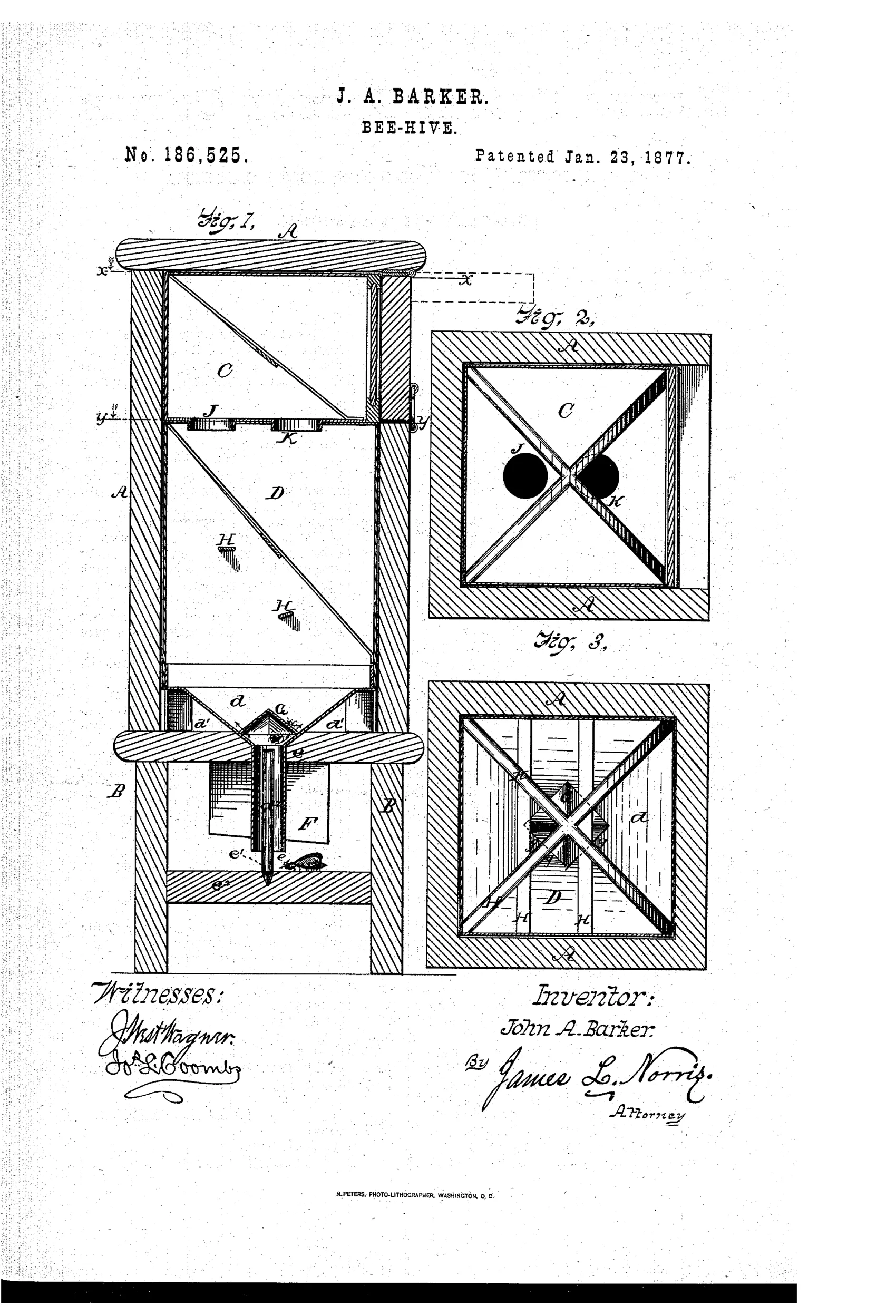
Moth-proof bee-hive with metal chambers
⬡ How it works
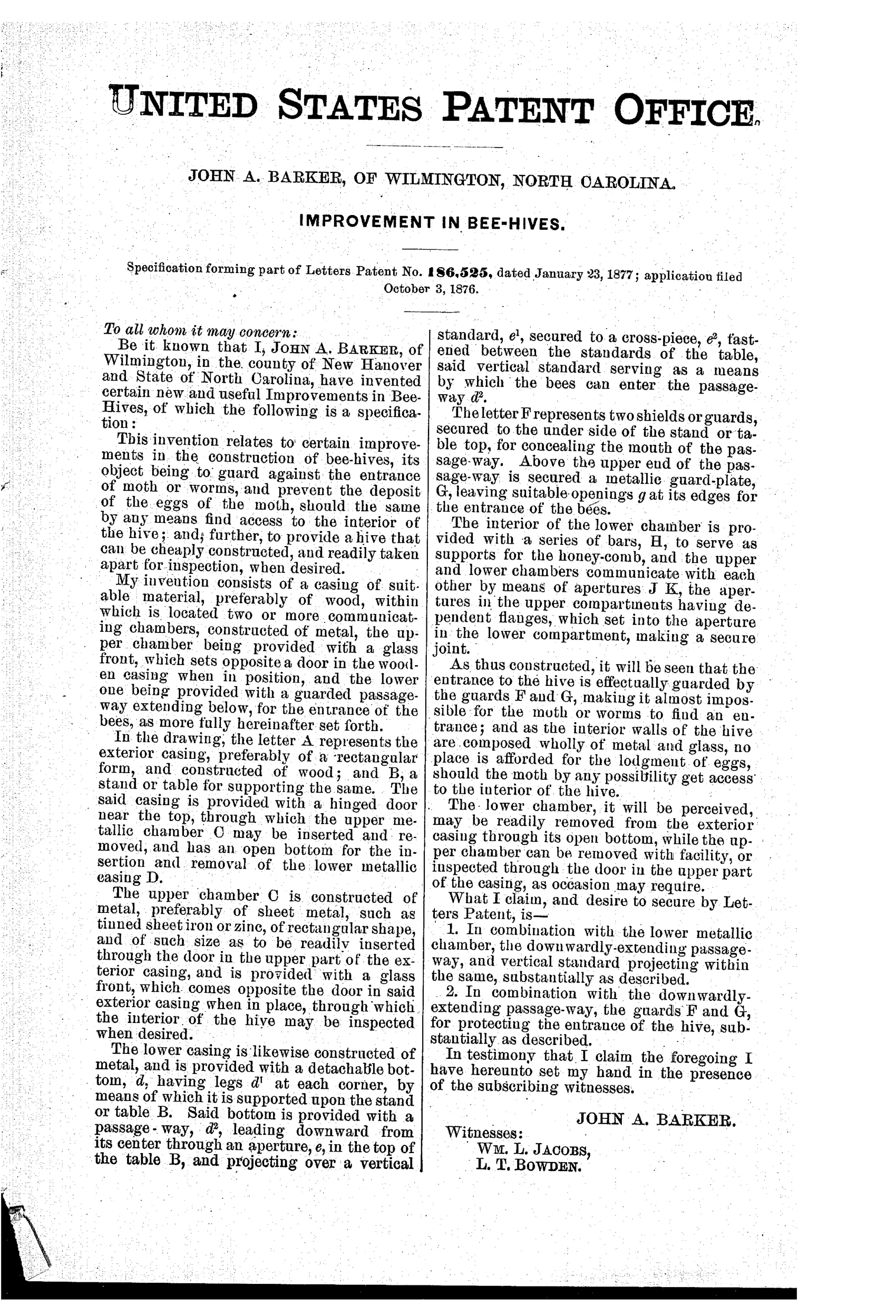
The hive consists of a wooden exterior casing enclosing two or more communicating metal chambers, an upper one with a glass front accessible through a hinged door, and a lower one with a detachable bottom accessible from below. Bees enter through a guarded downward passage-way with a vertical standard, protected by shields (F) beneath the stand and a metallic guard-plate (G) above, leaving only small edge openings for entry. The interior of the lower chamber holds bars (H) supporting the honey-comb, and the chambers communicate through apertures (J, K) fitted with dependent flanges for a secure joint. Because the interior walls are wholly metal and glass, no wood surfaces exist for moth eggs to lodge in, guarding against moth or worm infestation.
⬡ What was claimed
“1. In combination with the lower metallic chamber, the downwardly-extending passage-way, and vertical standard projecting within the same, substantially as described. 2. In combination with the downwardly-extending passage-way, the guards F and G, for protecting the entrance of the hive, substantially as described.”
In plain English: The invention claims a lower metal hive chamber with a downward entrance passage and internal standard, plus protective guard shields at the entrance to keep out moths and pests.
⬡ In the inventor’s words
“As thus constructed, it will be seen that the entrance to the hive is effectually guarded by the guards F and G, making it almost impossible for the moth or worms to find an entrance.”— John A. Barker, from the specification
Paper patent — likely never produced
The condensation problem of all-metal chambers and the cost of the double construction make production implausible, and no manufactured example or trade listing is known.
⬡ Commentary
Barker's whole design flows from one fixation: the wax moth. His answer is radical for 1877 — line the entire working interior of the hive with metal and glass, so there is no wooden crevice anywhere for a moth to lodge an egg. The wooden box you see in Fig. 1 is just a jacket; the bees live in two tinned chambers stacked inside it, communicating through flanged apertures (the two dark holes in Fig. 2). The entrance is equally paranoid: bees must come up from underneath, past a shield below the stand and a metal guard-plate above, squeezing through narrow edge gaps around a vertical standard.
What a casual reader will miss is what's absent. This is a quarter century after Langstroth, and there is not a movable frame in sight — just fixed bars (H) in the lower chamber, visible in Fig. 3. Barker is solving 1840s problems with 1840s architecture, only in sheet metal.
And the metal is the fatal flaw. A hive interior of tin is a condensation machine: warm, moist cluster air hitting cold metal walls means wet bees in winter, which kills colonies far more reliably than moths do. Beekeepers of the period knew this empirically, which is why wood won. A strong colony handles wax moths on its own; a metal box handles nothing. This is an earnest, well-drawn dead end.
Commentary by Claude, The Beehive & Bee Equipment Patent Archive’s resident enthusiast