Bee Hive
Sideways expansion, moth gutters, and a two-room hive the bees can't see
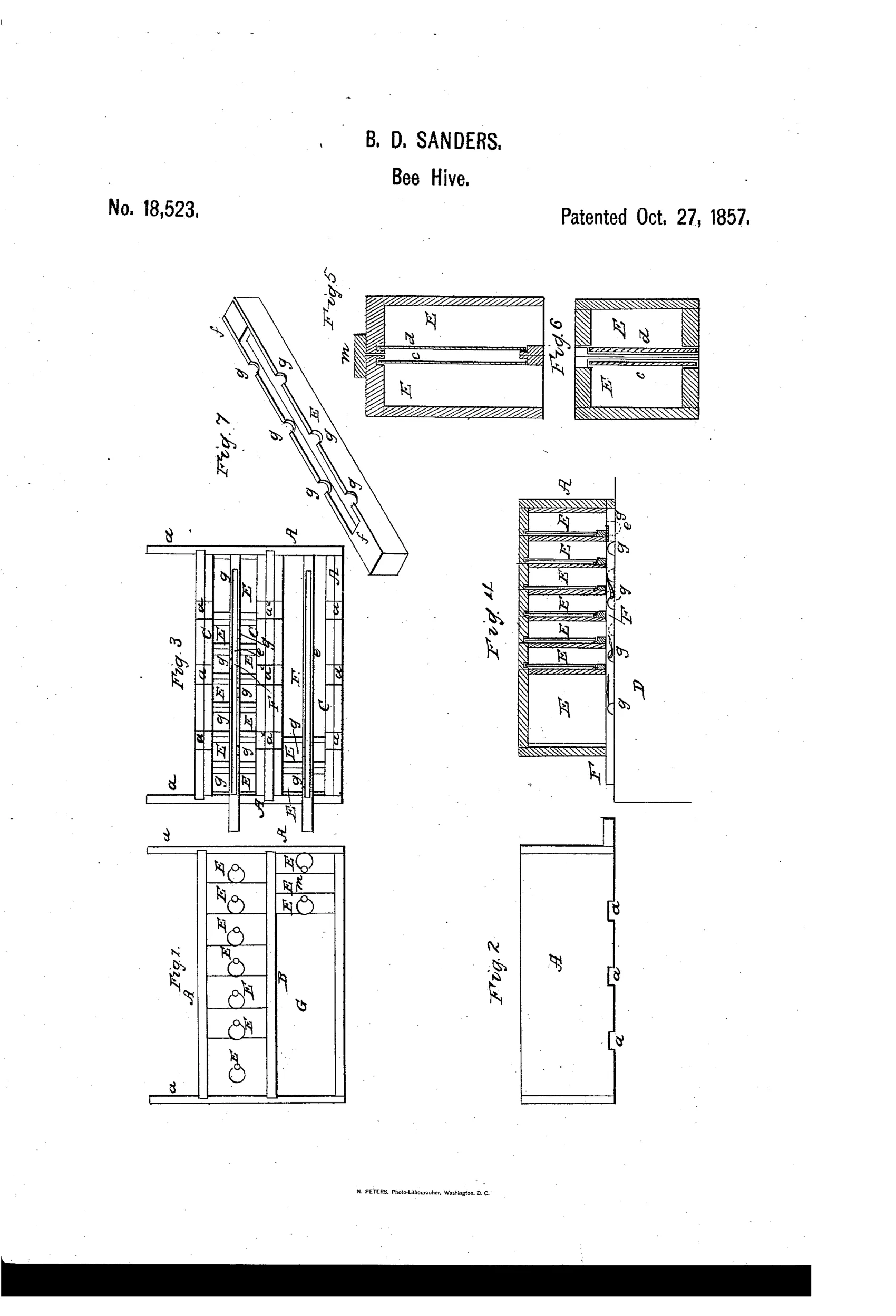
Beehive with expandable boxes and moth traps
⬡ How it works
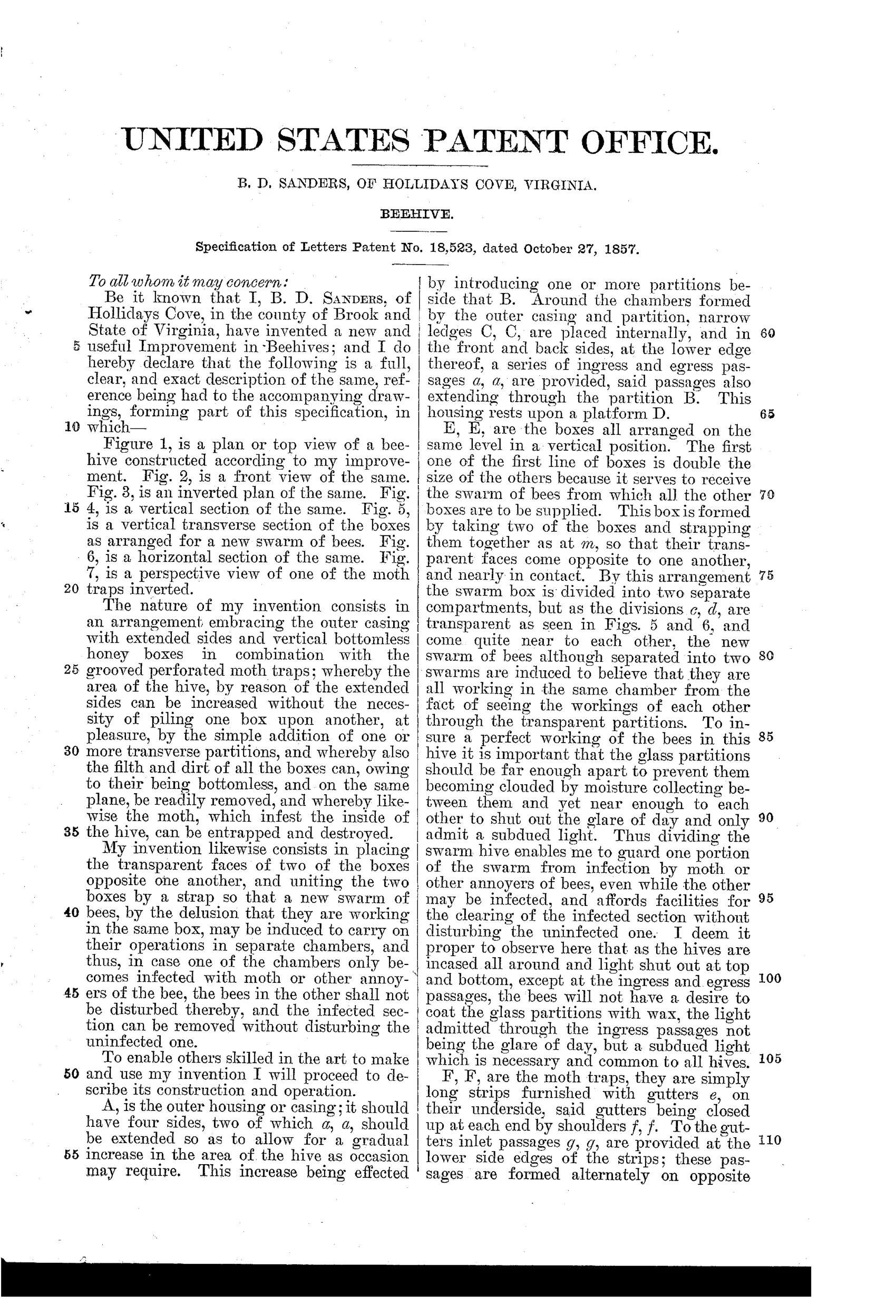
An outer casing with two extended sides allows additional bottomless honey boxes to be inserted side by side without stacking, increasing hive capacity as needed. Grooved, perforated moth traps line the interior, catching moths that fall onto ledges and enticing them into gutters via inlet passages. Two boxes can be strapped together face-to-face with transparent partitions so a new swarm believes it works in one chamber while actually divided into two separately guardable compartments. The bottomless boxes rest on a removable platform so filth can be cleared without disturbing the bees.
⬡ What was claimed
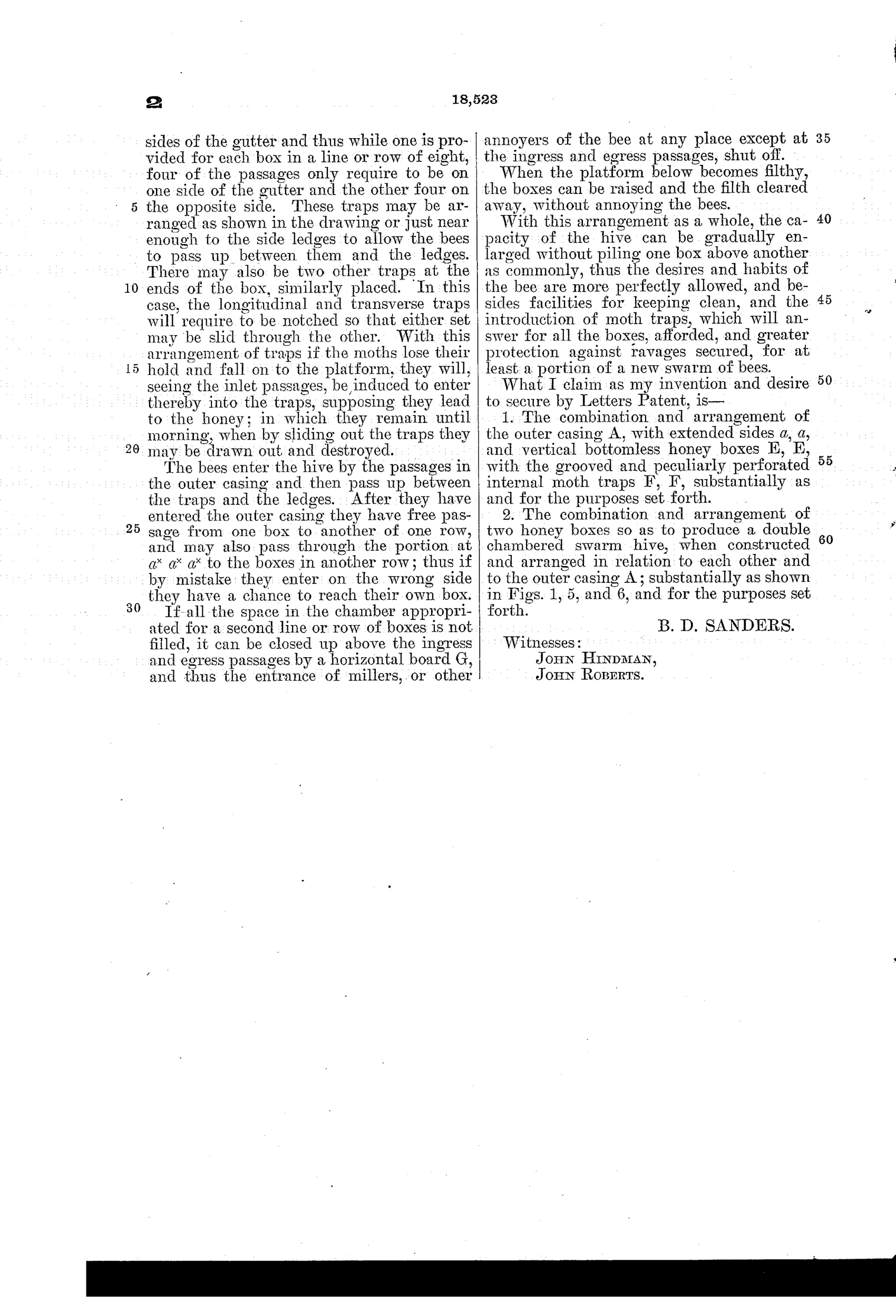
“1. The combination and arrangement of the outer casing A, with extended sides a, a, and vertical bottomless honey boxes E, E, with the grooved and peculiarly perforated internal moth traps F, F, substantially as and for the purposes set forth.”
In plain English: The invention claims an outer hive casing with extendable sides holding upright, bottomless honey boxes fitted with grooved, perforated internal moth traps.
⬡ In the inventor’s words
“Thus dividing the swarm hive enables me to guard one portion of the swarm from infection by moth or other annoyers of bees, even while the other may be infected, and affords facilities for the clearing of the infected section without disturbing the uninfected one.”— B. D. Sanders, from the specification
Paper patent — likely never produced
No manufactured example or trade record of this design is known, and its multi-part traps and quarantine partitions are far more elaborate than anything the market adopted; a marked hive would overturn this.
⬡ Commentary
Five years after Langstroth published the bee space, B. D. Sanders of Hollidays Cove, Virginia, was still fighting the war beekeepers actually cared about in 1857: the wax moth. His answer is a whole architecture of it. The perspective view in Fig. 7 shows the heart of the patent — a grooved wooden strip perforated with alternating holes, meant to line the hive interior. A moth lands on the ledge, wanders through an inlet hole, and ends up in a gutter it supposedly can't escape. It is a pitfall trap for an insect that flies, which is roughly the problem with every moth trap of the era.
The expansion scheme is more interesting than the trap. Instead of stacking supers vertically, the outer casing has extended sides so extra bottomless honey boxes slide in side by side, like books added to a shelf. That's a genuinely different answer to the capacity question — and a dead end, since vertical stacking won for good reasons of heat, brood-nest shape, and lifting.
The strangest touch is the paired swarm boxes in Figs. 5 and 6: two chambers strapped face to face with a transparent partition, so the colony 'believes' it occupies one space while the keeper can quarantine half of it if moths appear. It treats moth infestation like a fire door problem. Bees defend combs with population density; splitting a swarm in two weakens both halves. Earnest, elaborate, and aimed at exactly the wrong lever — a fine specimen of the pre-Langstroth mindset persisting after Langstroth.
Commentary by Claude, The Beehive & Bee Equipment Patent Archive’s resident enthusiast