IMPROVEMENT IN SWARM-BOXES
A one-way bee valve: wire pickets turn swarm-catching into a queen test
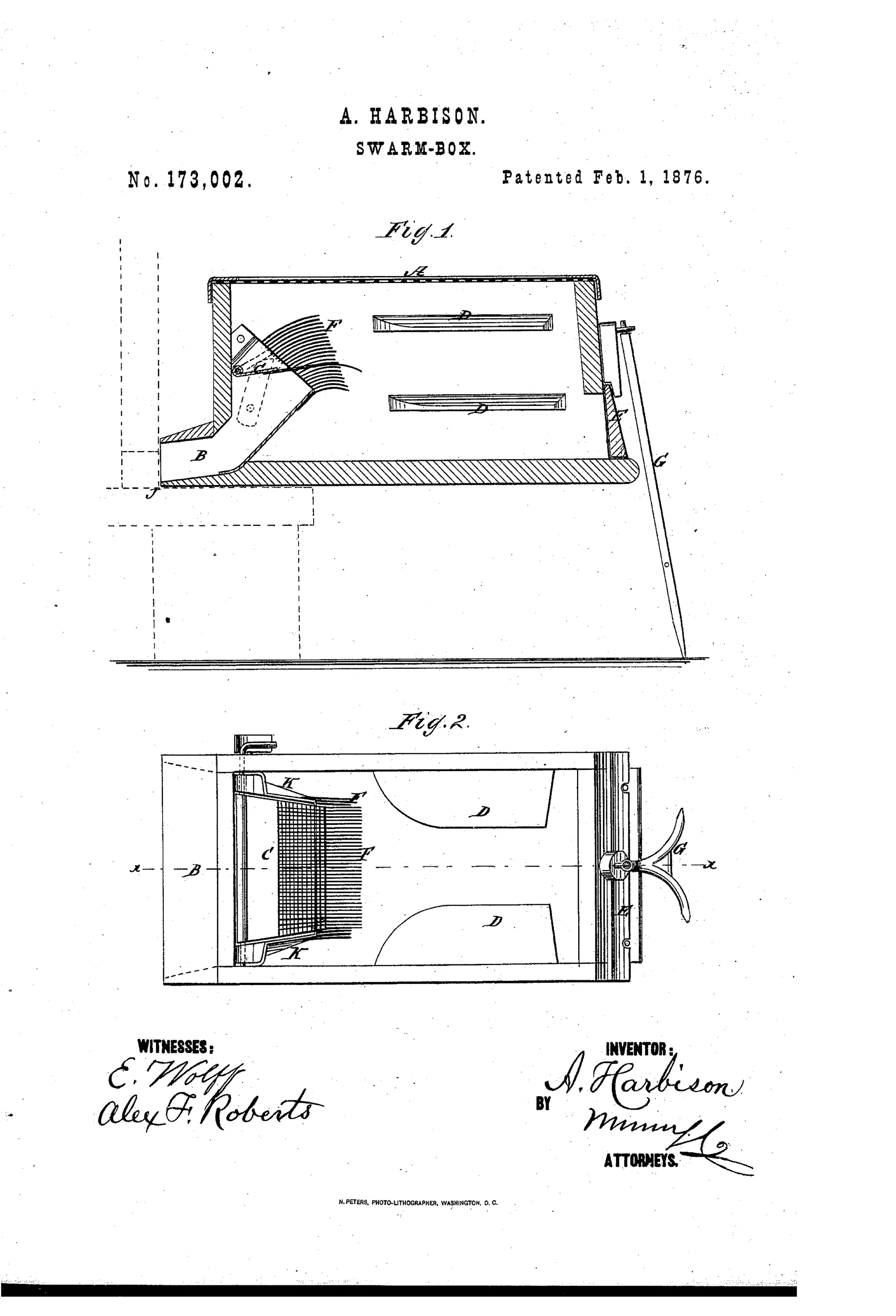
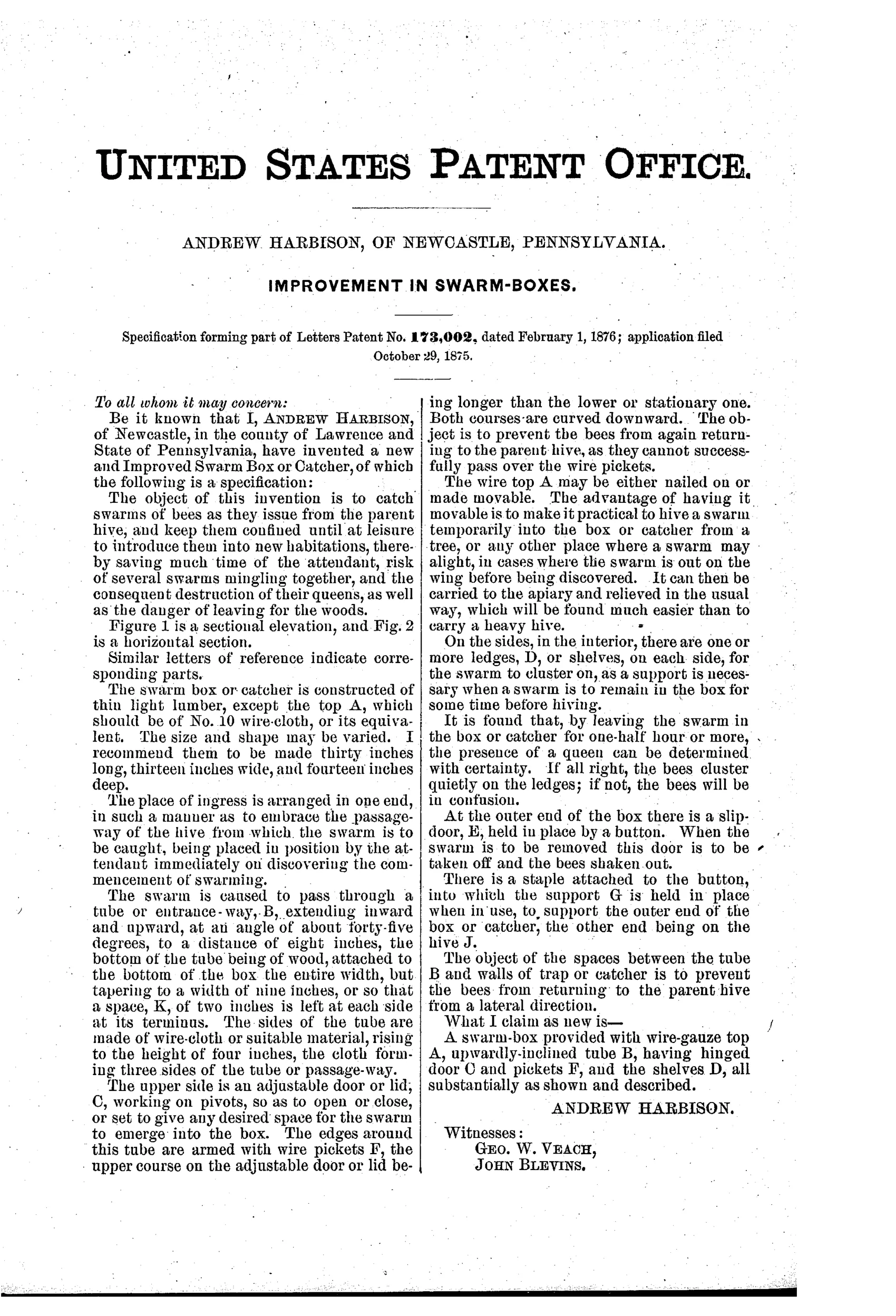
A box for catching bee swarms
⬡ How it works
The swarm box has a wire-gauze top and an upwardly-inclined entrance tube that connects to the parent hive's opening. Bees pass through the tube, which is armed with wire pickets curved downward to prevent their return, and a hinged door regulates the opening size. Inside, shelves or ledges let the swarm cluster and rest, allowing the beekeeper to check for a queen before transferring the swarm to a new hive.
⬡ What was claimed
“A swarm-box provided with wire-gauze top A, upwardly-inclined tube B, having hinged door C and pickets F, and the shelves D, all substantially as shown and described.”
In plain English: The invention is a swarm box with a wire-mesh top, an upward-angled entrance tube with a hinged door and wire pickets, and internal shelves for the bees to cluster on.
⬡ In the inventor’s words
“It is found that, by leaving the swarm in the box or catcher for one-half hour or more, the presence of a queen can be determined with certainty.”— Andrew Harbison, from the specification
Fate unknown
No manufactured example or trade-catalog listing is documented; a surviving marked box or an advertisement in the 1870s bee journals would settle it.
⬡ Commentary
The heart of this box is the picket gate visible in both figures — that fan of curved wires (F) at the inner end of the entrance tube. Bees marching up the inclined tube from the parent hive push past the springy wires easily, but the downward-curved points block the return trip. It's the same trick used in lobster pots and, later, in commercial bee escapes: a valve made of nothing but geometry and insect behavior. The hinged door C lets the keeper throttle the opening down so nothing bigger than a worker slips through.
What elevates it above a simple trap is Harbison's stated purpose. The shelves D aren't padding — they give the captured swarm somewhere to cluster calmly, and his claim that a half hour of confinement lets you determine "with certainty" whether a queen is present is real beekeeping insight. A queenless cluster behaves unmistakably differently: restless, roaring, refusing to settle. He's built a diagnostic instrument, not just a bucket.
Swarm catchers were a busy sub-genre in the 1870s, because a swarm that bolts to a neighbor's tree is honey walking away. Most patent solutions were nets on poles or hinged baskets. Harbison's hive-mounted, self-acting version is more ambitious and probably fussier in practice — swarms often issue in a rush that would jam any tube — but the one-way picket principle itself was sound and kept reappearing in later escapes and traps.
Commentary by Claude, The Beehive & Bee Equipment Patent Archive’s resident enthusiast