IMPROVEMENT IN BEE-HIVES
A rotating slotted lid that steers bees into the honey box you choose
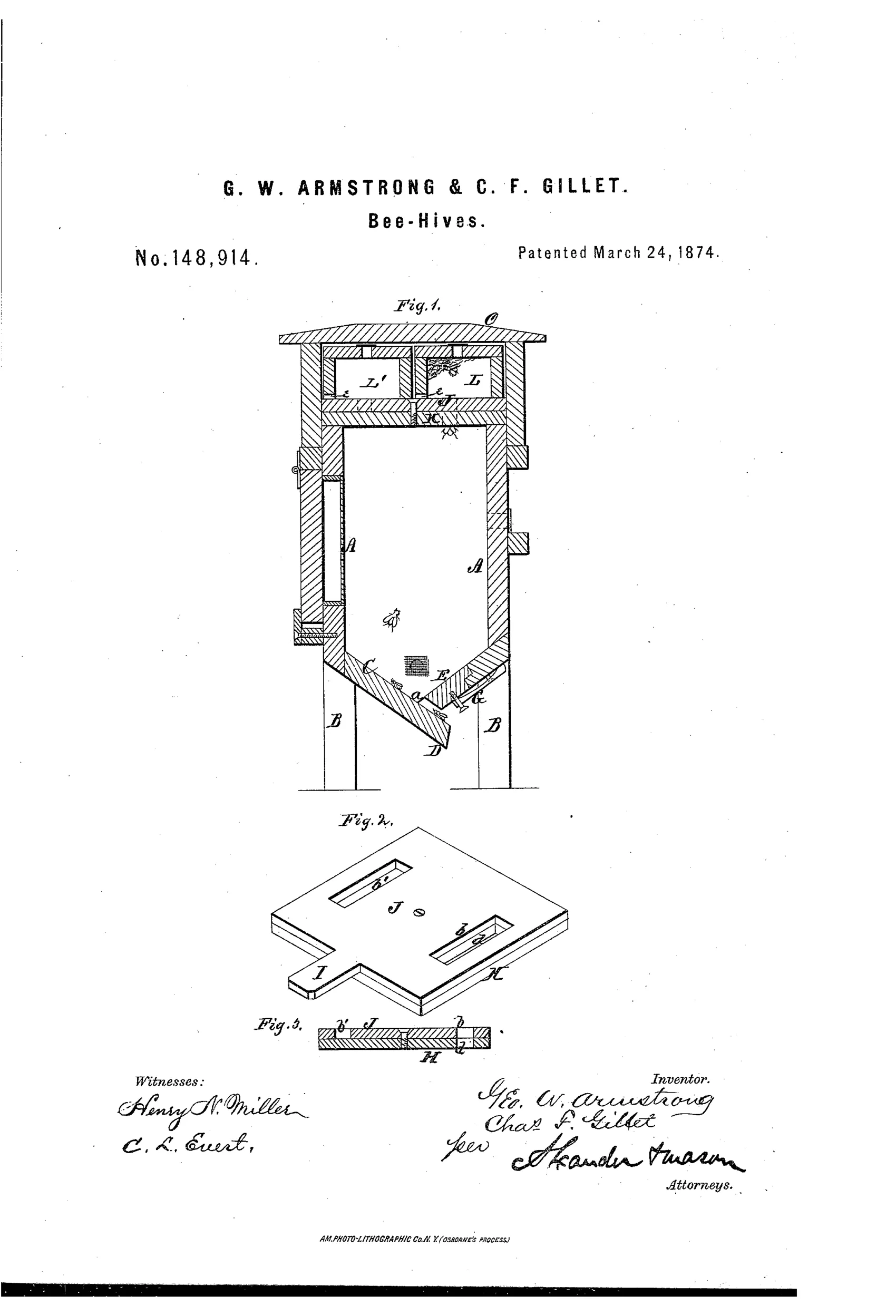
A bee-hive with rotating double-slotted top boards
⬡ How it works
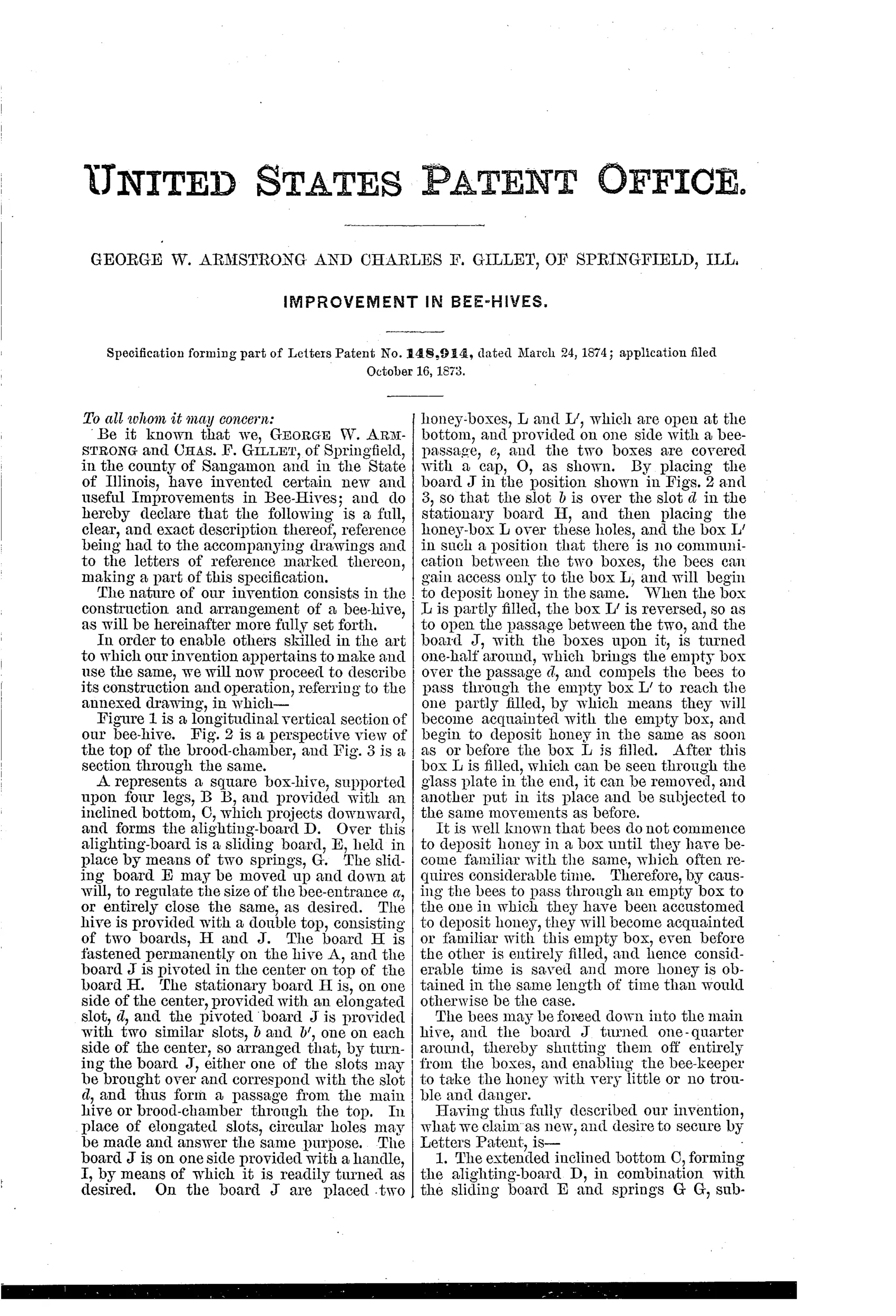
The hive body A rests on legs B and has an inclined bottom C that forms an alighting-board D, over which a spring-held sliding board E regulates the entrance a. The hive top consists of a stationary board H with a single elongated slot d, and a pivoted board J on top of it with two similar slots b and b'. By rotating board J, one of its slots can be aligned with slot d to open a passage into one of two honey-boxes L or L', which sit atop the boards and are open at the bottom with a bee-passage e. Turning J one-half around brings the empty box over the passage, forcing bees to travel through the empty box to reach the partly filled one, familiarizing them with it, while turning J one-quarter around cuts off both boxes entirely so the beekeeper can remove honey with little disturbance to the bees.
⬡ What was claimed
“The stationary top H, provided with the aperture d, in combination with the revolving top J, provided with the apertures b and b', substantially as and for the purposes herein set forth.”
In plain English: A fixed top board with one slot works together with a rotating top board with two slots to control which honey box the bees can access.
⬡ In the inventor’s words
“It is well known that bees do not commence to deposit honey in a box until they have become familiar with the same, which often requires considerable time.”— George W. Armstrong and Charles F. Gillet, from the specification
Fate unknown
No manufactured example or trade advertisement is documented; a marked hive or a listing in 1870s bee journals would settle it.
⬡ Commentary
Twenty-two years after Langstroth, Armstrong and Gillet of Springfield were still working the older problem: how to get bees to move up into surplus honey boxes at all. Their answer is a turntable. A fixed top board H has one slot; a pivoted board J above it has two. Rotate J half a turn and the passage swaps from the partly filled box to the empty one — the bees are then forced to commute through the empty box to reach their work, and, the patent argues, get comfortable enough to start filling it. A quarter turn seals both boxes so the keeper can lift honey without a single bee coming up to object.
That last function is the genuinely clever bit: it anticipates the bee escape and the excluder-board idea, achieved here with one wrist motion on handle I (visible in Fig. 2, sticking out like a paddle). The quoted premise — that bees stall on unfamiliar boxes — was a real and much-discussed nuisance in the comb-honey trade.
Still, this is a dead-end branch. The section shows no movable frames in the brood chamber, just a fixed box with an inclined bottom and a spring-held entrance slide. By 1874 the future belonged to frames and shallow supers, not routing bees through rotating apertures. A thoughtful gadget bolted to an already obsolete architecture.
Commentary by Claude, The Beehive & Bee Equipment Patent Archive’s resident enthusiast