IMPROVEMENT IN HONEY-BOXES FOR BEE-HIVES.
Mismatched strip widths turn every gap between honey boxes into a bee door
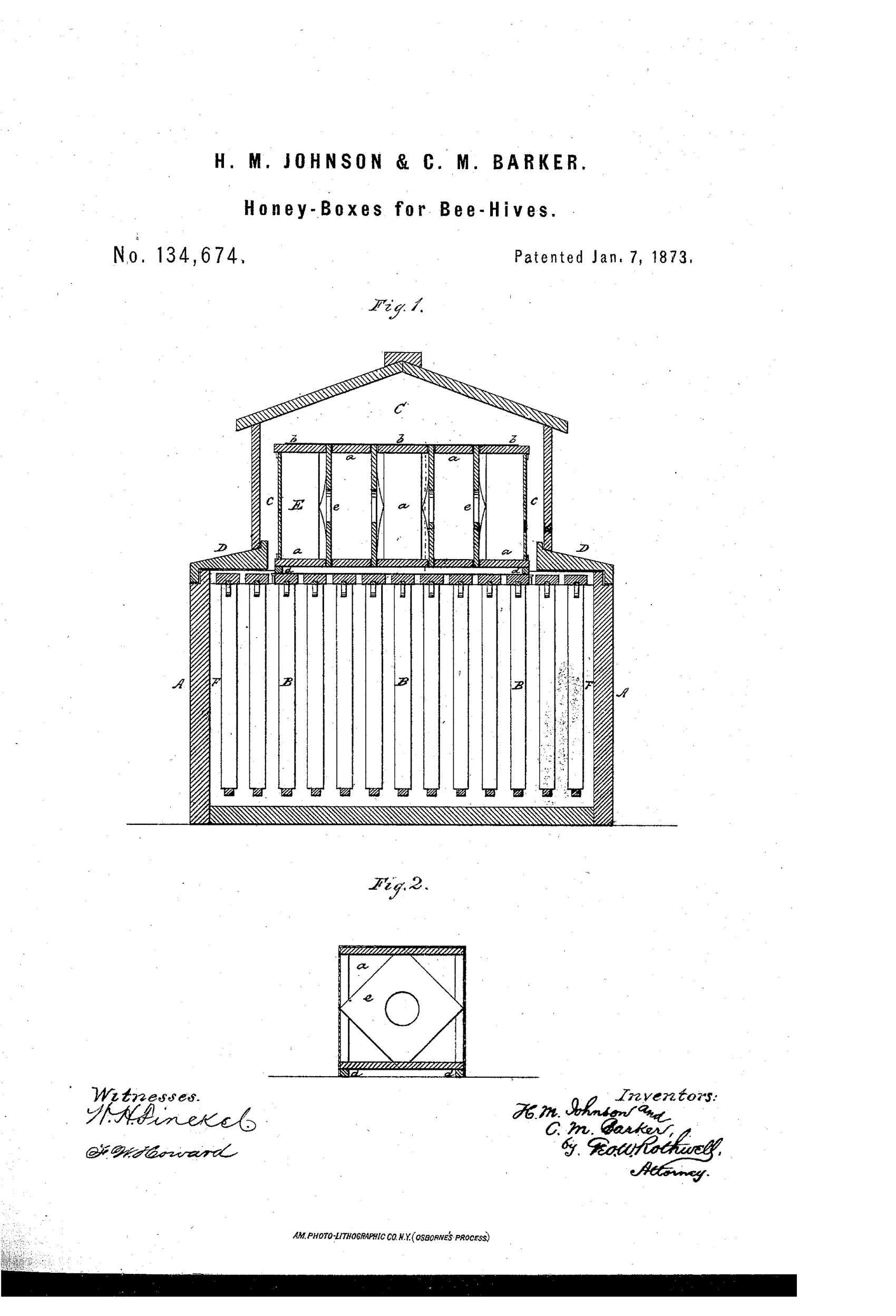
Sectional detachable honey-boxes for a bee-hive.
⬡ How it works
Each small honey-box is built of two narrow strips and two broad strips of wood arranged opposite each other, so their projecting edges form ledges for glass ends. When several boxes are placed side by side, the narrow strip of one box abuts the broad strip of the next, creating a gap on every side that serves as a bee entrance into each box. A group of these small boxes is temporarily united into one large box by strips nailed to the underside, then wrapped in paper on three sides and glazed on the ends to form a warm, tight super. Perforated division-boards inserted between the boxes encourage bees to build comb within each individual small box, and can be sprung out or removed to allow the boxes to be separated after filling and the paper cut apart for shipping as individual honey sections.
⬡ What was claimed
“1. A honey-box made of alternate broad and narrow strips of wood or other material and glass or other ends in such manner that when two or more boxes are arranged together, the narrow strips of one box being adjacent to the broad strips of the next, a space will be formed between said boxes on all sides, constituting entrances thereto.”
In plain English: A honey-box built from alternating broad and narrow wood strips with glass ends, so that when several boxes are grouped together the mismatched strip widths automatically leave gaps on every side that act as bee entrances.
⬡ In the inventor’s words
“We claim an advantage in thus making these entrances from the hive to the boxes come between the combs of honey, or between the small boxes, as the bees will then fill the whole space inside the small box, and also attach the comb to all four sides of said box, thus leaving it in better shape for shipping.”— Harley M. Johnson and Cassius M. Barker, from the specification
Fate unknown
No documented commercial production or surviving example is known to me; a glazed section box or supply catalog listing from mid-1870s Michigan would settle it.
⬡ Commentary
This is comb-honey section design in its awkward adolescence, four years before the one-piece basswood section swept the field. Johnson and Barker's trick is genuinely neat: each little box is built of two broad strips and two narrow strips, so when you shove a row of them together, narrow always meets broad and a slot opens on every side. No drilled entrance holes, no fussy alignment — the geometry does the work. The bees walk in between the combs, which the inventors argue makes them attach the comb to all four walls, leaving a section sturdy enough to survive shipping.
Fig. 1 shows the whole arrangement riding as a super over a proper frame hive — this is post-Langstroth thinking through and through, aimed at the retail comb-honey market rather than at reinventing the hive. The odder details are the packaging: the group of boxes gets wrapped in paper on three sides for warmth (bees do finish comb faster in a snug super), and after harvest you cut the paper apart and each glazed box is its own display-ready product. Fig. 2's spring-out perforated division boards are there to bully the bees into filling each box separately instead of festooning comb across the lot.
As a system it would work, but it is fiddly — glass ends, paper wrapping, nailed-on temporary strips — exactly the labor the folding one-piece section soon eliminated. A clever dead end, and a good marker of what the section-box crowd was chasing in 1873.
Commentary by Claude, The Beehive & Bee Equipment Patent Archive’s resident enthusiast