IMPROVEMENT IN BEE-HIVES
A Missouri hive that bets everything on outsmarting the wax moth
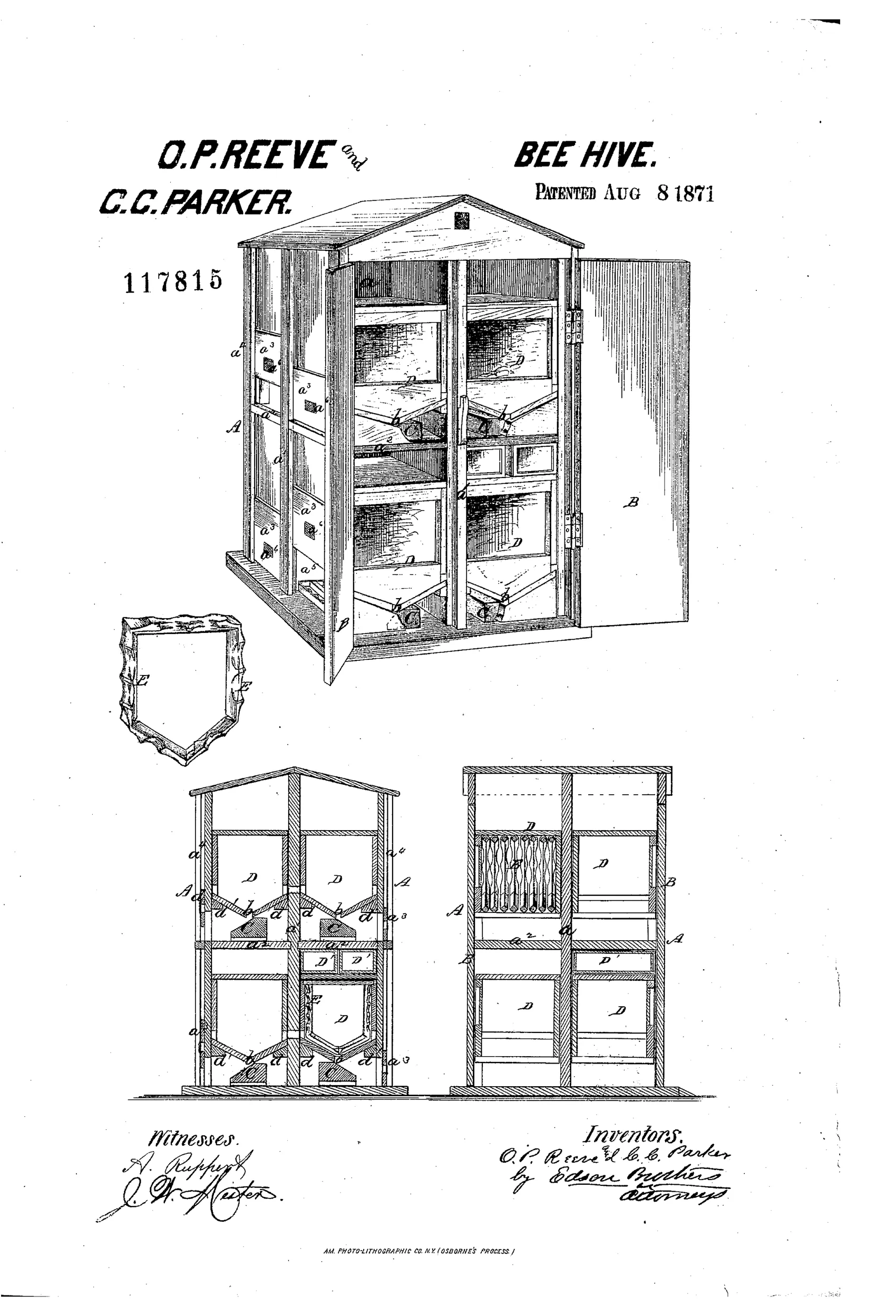
A multi-chamber beehive with moth traps
⬡ How it works
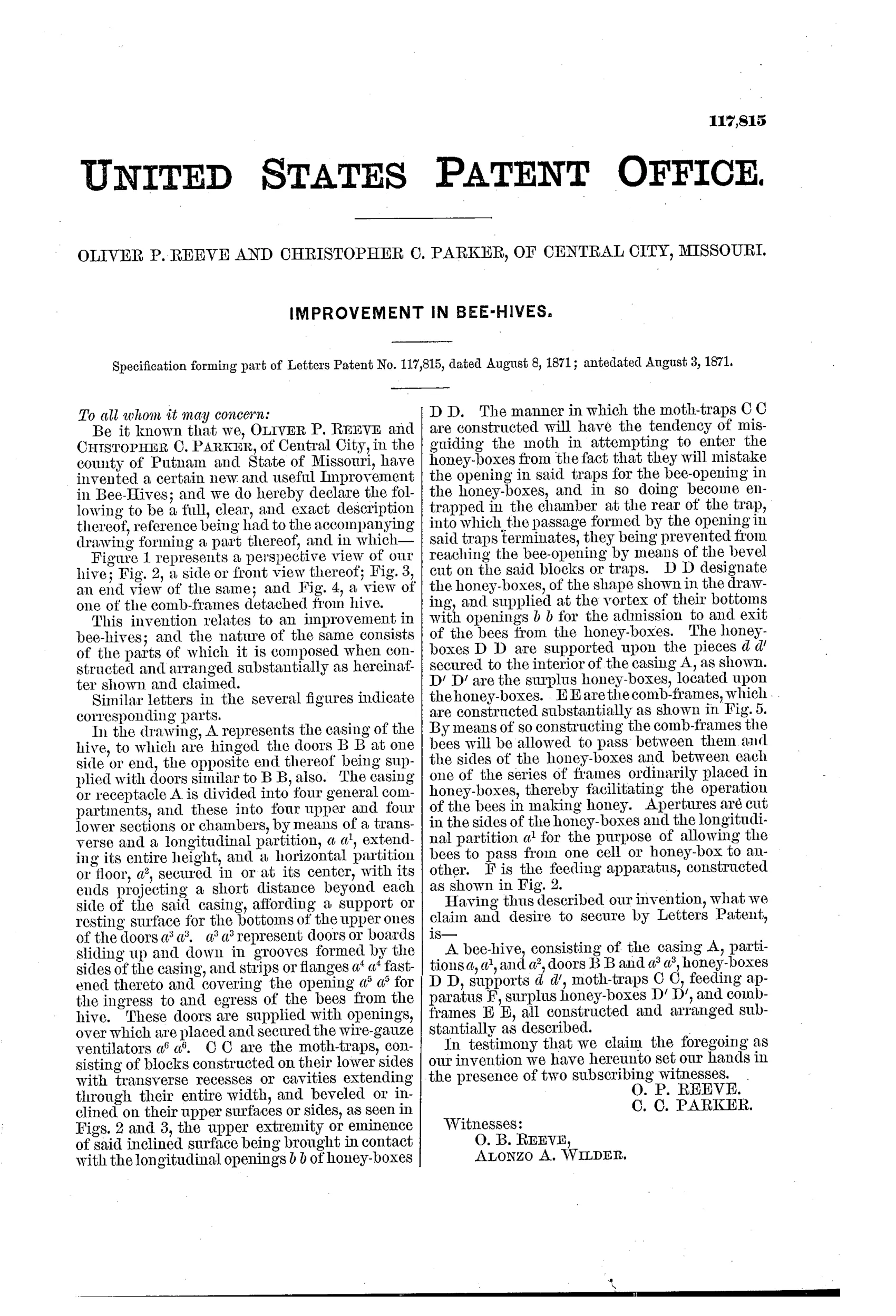
The hive casing is divided into four upper and four lower compartments by transverse and longitudinal partitions and a horizontal floor. Sliding doors covered with wire-gauze ventilators control bee ingress and egress, while beveled moth-trap blocks mislead moths away from the honey-boxes into a rear chamber. Honey-boxes with openings at their bottoms allow bees to pass in and out, and comb-frames are constructed to let bees move between the frames and the sides of the boxes. A feeding apparatus and surplus honey-boxes are also incorporated into the design.
⬡ What was claimed
“A bee-hive, consisting of the casing A, partitions a, a1, and a2, doors B B and a3 a3, honey-boxes D D, moth-traps C C, feeding apparatus F, surplus honey-boxes D' D', and comb-frames E E, all constructed and arranged substantially as described.”
In plain English: The invention is the complete beehive assembly, including its casing, partitions, doors, honey-boxes, moth traps, feeder, surplus boxes, and comb-frames, built and arranged as described.
⬡ In the inventor’s words
“The manner in which the moth-traps C C are constructed will have the tendency of misguiding the moth in attempting to enter the honey-boxes from the fact that they will mistake the opening in said traps for the bee-opening in the honey-boxes, and in so doing become entrapped in the chamber at the rear of the trap.”— Oliver P. Reeve and Christopher C. Parker, from the specification
Fate unknown
No manufactured example or advertisement is documented; a marked hive or a Central City-area sales notice would settle it.
⬡ Commentary
Reeve and Parker's hive is a fine specimen of the 1870s moth-trap palace: eight compartments, ventilated sliding doors, a built-in feeder, surplus honey-boxes, and — the centerpiece — beveled trap blocks meant to fool the wax moth. The theory, stated with total confidence in the patent, is that a moth hunting for the bee entrance will 'mistake the opening in said traps for the bee-opening' and blunder into a dead-end chamber behind it. It's decoy architecture for an insect, and like nearly all such traps of the era, it asks the moth to be dumber than it is. Moths follow scent and follow bees; they don't read floor plans.
The drawing rewards a closer look. Fig. 4 shows a comb-frame built to leave passage between the frame and the box walls — the inventors clearly knew Langstroth's bee space, nineteen years old by 1871, and paid it lip service. But the frames sit inside honey-boxes, inside compartments, inside a hinged cabinet, so a beekeeper wanting one comb has to open three layers of joinery. That's the era's central confusion: adopting the movable frame while burying it in furniture.
The single omnibus claim — every part 'constructed and arranged substantially as described' — is the weakest kind of protection, and tells you this was two earnest men patenting their own hive rather than a design headed for a factory.
Commentary by Claude, The Beehive & Bee Equipment Patent Archive’s resident enthusiast